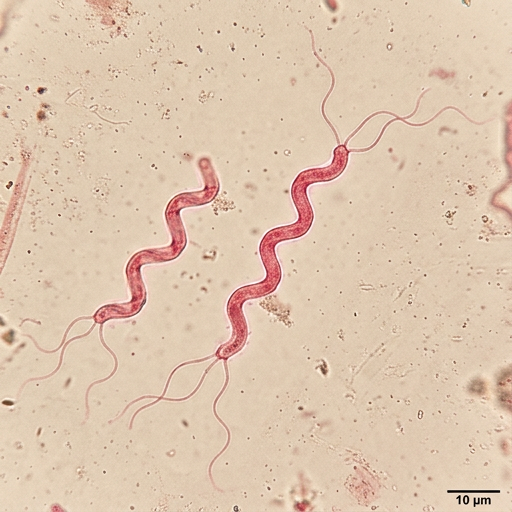
Spirosoma linguale DSM 74

Gram-negativeSpirillaNon-motileAerobe

Kingdom

Pseudomonadati

Phylum

Bacteroidota

Class

Cytophagia

Order

Cytophagales

Family

Cytophagaceae

Genus

Spirosoma

Description

Spirosoma linguale DSM 74 is a gram-negative, spiral-shaped bacterium that thrives optimally at mesophilic temperatures, is classified as a chemoheterotroph, and functions as a facultative anaerobe. This microorganism is found in a variety of environmental niches, including the human oral cavity; its presence reflects the dynamic microbial ecosystem that exists in and on human bodies.The gram-negative nature of Spirosoma linguale indicates that it has a thin peptidoglycan layer surrounded by an outer membrane containing lipopolysaccharides, which contributes to its distinctive staining characteristics and plays a vital role in its interaction with host organisms. Its spiral morphology allows for increased motility, which is advantageous for navigating through viscous environments such as mucosal surfaces. As a mesophilic organism, Spirosoma linguale exhibits growth preferences that align with moderate temperature ranges, typically between 20°C and 45°C. This temperature adaptability enables it to thrive in various habitats, aligning with the thermal conditions of the human oral cavity, which is often subject to fluctuating temperatures. Being a chemoheterotroph, Spirosoma linguale derives its energy from organic compounds, predominantly found in the microbial communities of the mouth. As a facultative anaerobe, it can grow in both the presence and absence of oxygen, allowing it to exploit diverse ecological niches and adjust its metabolic pathways depending on environmental conditions. A notable aspect of Spirosoma linguale is its potential role in oral health. Studies suggest that it may influence the balance of oral microbiota, possibly impacting conditions such as dental caries and periodontal disease. Its unique morphology and metabolic capabilities make it a subject of interest for researchers exploring microbial ecology and its implications for human health.

Taxonomy

KingdomPseudomonadati
PhylumBacteroidota
ClassCytophagia
OrderCytophagales
FamilyCytophagaceae
GenusSpirosoma
SpeciesSpirosoma linguale
StrainDSM 74

Profile

Physiology
Gram staining propertiesNegative
ShapeSpirilla
MobilityNo
Flagellar presenceYes
Number of membranes2
Ecology, Host, and Life Cycle
Oxygen requirementsAerobe
Optimal temperature20
Temperature rangeMesophilic
HabitatMultiple
Biotic relationshipFree living
Host(s)Not Available
Cell arrangementNot Available
SporulationNonsporulating
Energy sourceChemoorganotroph
PathogenicityNo

Genome Summary

Spirosoma linguale DSM 74

Accession NumberNC_013734.1

Gene Summary

Adenine Count

2597 bp

Thymine Count

2601 bp

Guanine Count

2344 bp

Cytosine Count

2423 bp

Genome Length

9965 bp

Protein-coding Genes

12 genes

Non-Coding Genes

0 genes

# of Chromosomes/Plasmids

9

Genes

NameLocus TagUniProtStrandCoordinatesMolecular Weight
replication initiation proteinSLIN_RS34420Not Available+668 - 164237708.6
brnt family toxinSLIN_RS34425Not Available+1635 - 195512240.3
hypothetical proteinSLIN_RS34430Not Available-2098 - 271822895.3
relaxase/mobilization nuclease domain-containing proteinSLIN_RS34435Not Available-2720 - 360433404.8
plasmid mobilization proteinSLIN_RS34440Not Available-3601 - 395712840.5
outer membrane beta-barrel proteinSLIN_RS34445Not Available+4191 - 482322820.2
hypothetical proteinSLIN_RS34450Not Available-4830 - 515011986.2
phosphatase pap2 family proteinSLIN_RS34455Not Available-5741 - 660431685.5
terb family tellurite resistance proteinSLIN_RS34460Not Available+6954 - 771526683.0
hypothetical proteinSLIN_RS34465Not Available+7816 - 80679253.36

Displaying genes 1 – 10 of 6884 in total

Pathways

7 pathways

Metabolites

14 records
Metabolite IDMetabolite nameStructureCAS number
BASm0001167triphosphateO10P3Chemical structure of triphosphate14127-68-5
Average252.9153Da
Monoisotopic252.8704308Da
BASm0001661Cu(2+)CuChemical structure of Cu(2+)7440-50-8
Average63.546Da
Monoisotopic62.929601079Da
BASm0001865diphosphateHO7P2Chemical structure of diphosphateNot available
Average174.95Da
Monoisotopic174.9213971Da
BASm00021577-cyano-7-deazaguanineC7H5N5OChemical structure of 7-cyano-7-deazaguanineNot available
Average175.1475Da
Monoisotopic175.0494098Da
BASm0002759dTDP-beta-L-rhamnoseC16H24N2O15P2Not availableNot available
Average546.316Da
Monoisotopic546.066289237Da
BASm0017263NADPC21H29N7O17P3Chemical structure of NADP53-59-8
Average744.4129Da
Monoisotopic744.083277073Da
BASm0017265Uridine diphosphate-N-acetylglucosamineC17H27N3O17P2Chemical structure of Uridine diphosphate-N-acetylglucosamine528-04-1
Average607.3537Da
Monoisotopic607.081569477Da
BASm0017310dTDP-D-GlucoseC16H26N2O16P2Chemical structure of dTDP-D-Glucose2196-62-5
Average564.329Da
Monoisotopic564.075755818Da
BASm0017620TDP-RhamnoseC17H26N2O14P2Chemical structure of TDP-RhamnoseNULL
Average544.3409Da
Monoisotopic544.085926574Da
BASm0019034epoxyqueuosineC17H23N5O8Chemical structure of epoxyqueuosineNULL
Average425.3932Da
Monoisotopic425.154662737Da

Displaying 1–10 of 14 metabolites