
Kingdom
Pseudomonadati
Phylum
Bacteroidota
Class
Bacteroidia
Order
Bacteroidales
Family
Bacteroidaceae
Genus
Phocaeicola
Description
Taxonomy
| Kingdom | Pseudomonadati |
|---|---|
| Phylum | Bacteroidota |
| Class | Bacteroidia |
| Order | Bacteroidales |
| Family | Bacteroidaceae |
| Genus | Phocaeicola |
| Species | Phocaeicola vulgatus |
| Strain | strain AM13-21 |
Profile
| Physiology | |
|---|---|
| Gram staining properties | Positive |
| Shape | Rod |
| Mobility | No |
| Flagellar presence | Yes |
| Number of membranes | 2 |
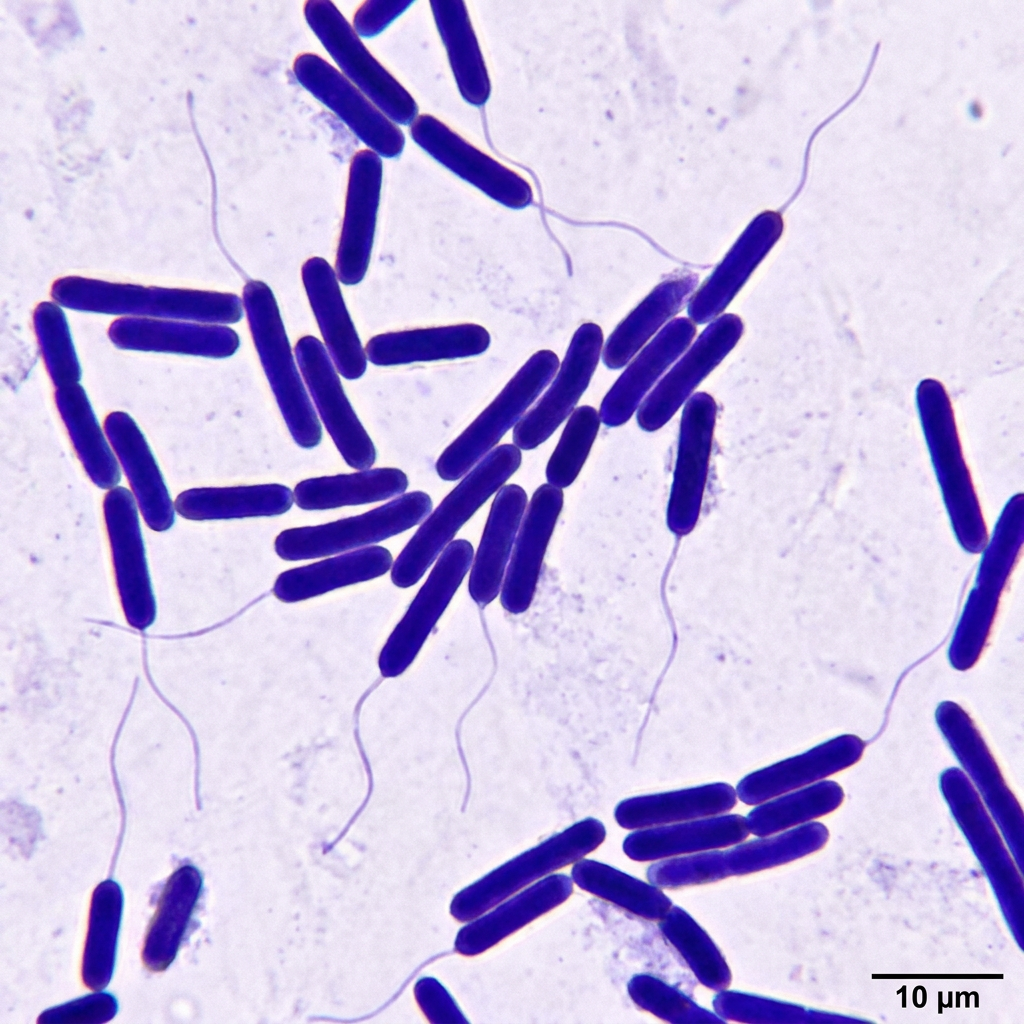
AI-generated image based on bacteria physiology
| Ecology, Host, and Life Cycle | |
|---|---|
| Oxygen requirements | Anaerobe |
| Optimal temperature | Not Available |
| Temperature range | Mesophilic |
| Habitat | HostAssociated |
| Biotic relationship | Free living |
| Host(s) | Homo sapiens |
| Cell arrangement | Singles |
| Sporulation | Not Available |
| Energy source | Not Available |
| Pathogenicity | Not Available |
Gene Summary
Adenine Count
1539821 bp
Thymine Count
1499100 bp
Guanine Count
1070173 bp
Cytosine Count
1133878 bp
Genome Length
5243870 bp
Protein-coding Genes
4129 genes
Non-Coding Genes
75 genes
# of Chromosomes/Plasmids
1
Genes
| Name | Locus Tag | UniProt ID | Strand Orientation | Gene Start/End | Protein Molecular Weight |
|---|---|---|---|---|---|
| formate--tetrahydrofolate ligase | DW150_01250 | Not Available | Positive | 359993 - 361660 | 60514.0 |
| hypothetical protein | DW150_01255 | Not Available | Negative | 361692 - 361919 | 8214.64 |
| hypothetical protein | DW150_01260 | Not Available | Positive | 362043 - 362279 | 8909.6 |
| s9 family peptidase | DW150_01265 | Not Available | Positive | 362312 - 365026 | 102653.0 |
| glycine dehydrogenase (aminomethyl-transferring) | DW150_01270 | Not Available | Negative | 365156 - 368005 | 105282.0 |
| mbl fold metallo-hydrolase | DW150_01275 | Not Available | Negative | 368041 - 368679 | 23875.4 |
| ribosomal rna small subunit methyltransferase g | DW150_01280 | Not Available | Negative | 368697 - 369326 | 23835.2 |
| duf3298 domain-containing protein | DW150_01285 | Not Available | Negative | 369347 - 370195 | 32058.1 |
| cu(2+)-exporting atpase | DW150_01290 | Not Available | Positive | 370374 - 372587 | 79953.9 |
| hypothetical protein | DW150_01295 | Not Available | Negative | 372674 - 373222 | 20508.7 |
Pathways
0 pathways
No pathways found
No metabolic pathways have been associated with this bacterium yet.
Health Effects
No health effects information available for this bacterium.
