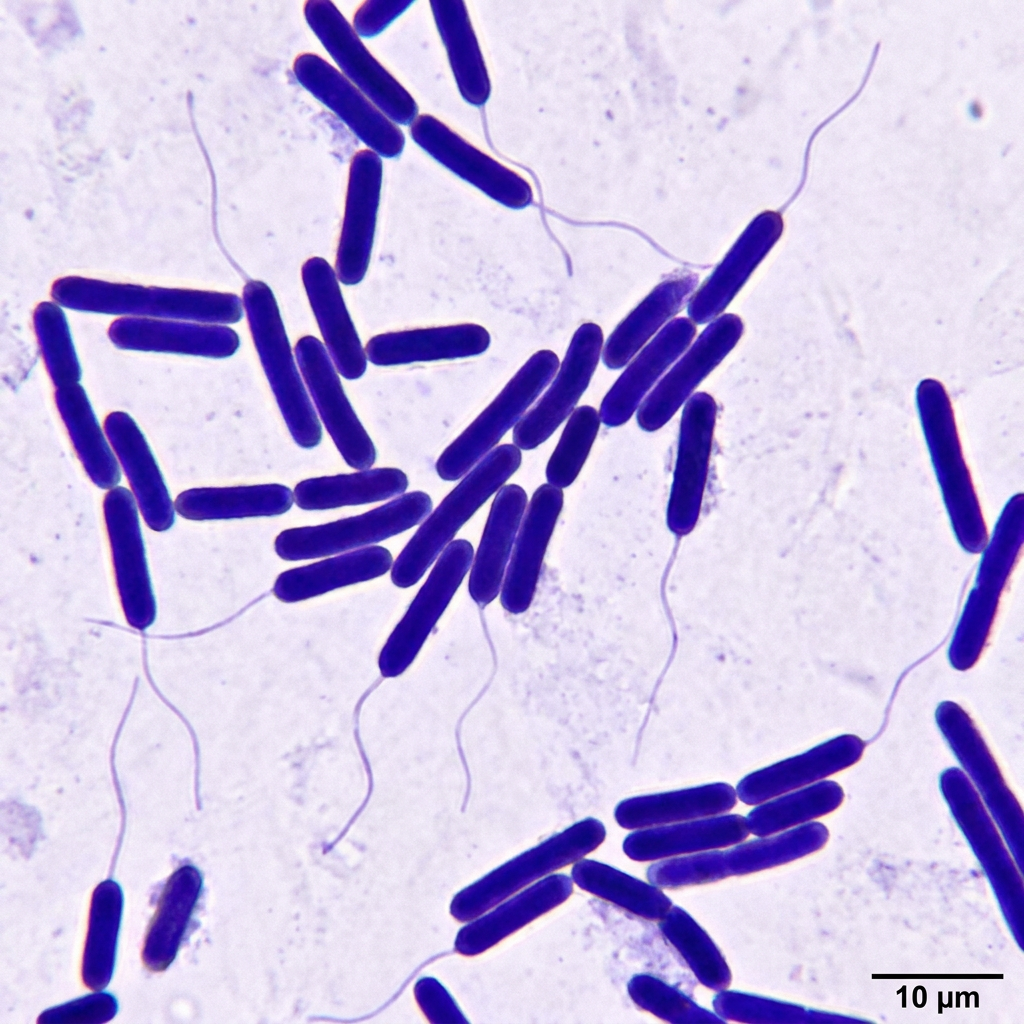
Bifidobacterium bifidum S17

Gram-positiveRodNon-motileAnaerobe

Kingdom

Bacillati

Phylum

Actinomycetota

Class

Actinomycetes

Order

Bifidobacteriales

Family

Bifidobacteriaceae

Genus

Bifidobacterium

Description

Bifidobacterium bifidum S17 is a microorganism that exhibits the following characteristics: mesophile, chemoheterotroph, anaerobic energy production, Gram-variable, rod-shaped, found in the gastrointestinal tract of humans, obligate anaerobe. As a mesophile, Bifidobacterium bifidum S17 thrives in temperatures ranging from 25°C to 45°C, making it well-suited to inhabit the human gastrointestinal tract. Its chemoheterotrophic metabolism means that it obtains energy by breaking down organic compounds, rather than producing its own food through photosynthesis. This microbe relies on anaerobic energy production, suggesting that it is adapted to environments with low oxygen levels. Gram-variable staining indicates that Bifidobacterium bifidum S17 has an irregular or uncertain cell wall structure, which can affect its interaction with the human immune system. In terms of shape, this microbe is rod-shaped, which can facilitate its movement and competition for nutrients within the gastrointestinal tract. Its abundance in the human gastrointestinal tract, particularly in infants, plays a crucial role in the development of the gut microbiome. As an obligate anaerobe, Bifidobacterium bifidum S17 requires an environment with no oxygen present to survive and replicate. This is likely due to the presence of oxygen-sensitive enzymes and its reliance on anaerobic energy production. Moreover, Bifidobacterium bifidum S17 has been increasingly recognized for its potential health benefits, including the production of short-chain fatty acids, modulation of the immune system, and improvement of nutrient absorption in the gut. The strain S17 has been extensively studied due to its ability to produce bifidin, a polysaccharide with prebiotic properties, which can promote the growth of beneficial microorganisms in the gut. Overall, Bifidobacterium bifidum S17 is a significant component of the human microbiome, and its unique characteristics have sparked significant interest in its potential applications in human health and disease.

Taxonomy

KingdomBacillati
PhylumActinomycetota
ClassActinomycetes
OrderBifidobacteriales
FamilyBifidobacteriaceae
GenusBifidobacterium
SpeciesBifidobacterium bifidum
StrainS17

Profile

Physiology
Gram staining propertiesPositive
ShapeRod
MobilityNo
Flagellar presenceYes
Number of membranes1
Image of Bifidobacterium bifidum S17
AI-generated image based on bacteria physiology
Ecology, Host, and Life Cycle
Oxygen requirementsAnaerobe
Optimal temperatureNot Available
Temperature rangeMesophilic
HabitatHostAssociated
Biotic relationshipFree living
Host(s)Homo sapiens
Cell arrangementNot Available
SporulationNonsporulating
Energy sourceNot Available
PathogenicityNo

Genome Summary

Bifidobacterium bifidum S17


Gene Summary

Adenine Count

406900 bp

Thymine Count

407529 bp

Guanine Count

686228 bp

Cytosine Count

686225 bp

Genome Length

2186882 bp

Protein-coding Genes

1768 genes

Non-Coding Genes

76 genes

# of Chromosomes/Plasmids

1

Genes

NameLocus TagUniProtStrandCoordinatesMolecular Weight
AttlNot AvailableNot Available+90873 - 90884Not Available
Helix-turn-helix dna binding domain proteinBBIF_RS00445Not Available+98215 - 9901529528.7
Hnh endonucleaseBBIF_RS00450Not Available+99099 - 9944012862.2
hypothetical proteinBBIF_RS00455Not Available+99561 - 9995613970.6
TerminaseBBIF_RS00460Not Available+99916 - 10136752921.3
Portal proteinBBIF_RS00465Not Available+101364 - 10283953837.6
Muf-like minor capsid proteinBBIF_RS00470Not Available+102766 - 10394445253.4
hypothetical proteinBBIF_RS00475Not Available+103902 - 1041479020.46
Trna-tyr;Not AvailableNot Available+104210 - 104294Not Available
Gp7BBIF_RS00485Not Available+104357 - 10495021197.9

Displaying genes 1 – 10 of 1844 in total

Pathways

0 pathways

No pathways found

No metabolic pathways have been associated with this bacterium yet.

Metabolites

104 records
Metabolite IDMetabolite nameStructureCAS number
BASm0000989GlycerolC3H8O3Chemical structure of Glycerol56-81-5
Average92.0938Da
Monoisotopic92.04734412Da
BASm0001661Cu(2+)CuChemical structure of Cu(2+)7440-50-8
Average63.546Da
Monoisotopic62.929601079Da
BASm0001921(S)-3-methyl-2-oxopentanoateC6H9O3Chemical structure of (S)-3-methyl-2-oxopentanoate1460-34-0
Average129.1339Da
Monoisotopic129.0551692Da
BASm0002143menaquinone-7C46H64O2Chemical structure of menaquinone-7Not available
Average648.9992Da
Monoisotopic648.4906313Da
BASm0002780orotidine 5'-phosphateC10H10N2O11PNot available2149-82-8
Average365.168Da
Monoisotopic365.003866888Da
BASm0003070D-methionineC5H11NO2SChemical structure of D-methionine348-67-4
Average149.211Da
Monoisotopic149.0510493Da
BASm0003462(2S)-2-[5-amino-1-(5-phospho-beta-D-ribosyl)imidazole-4-carboxamido]succinateC13H19N4O12PChemical structure of (2S)-2-[5-amino-1-(5-phospho-beta-D-ribosyl)imidazole-4-carboxamido]succinate3031-95-6
Average454.2833Da
Monoisotopic454.0737086Da
BASm0005086D-galactosamine 6-phosphateC6H14NO8PChemical structure of D-galactosamine 6-phosphate3616-42-0
Average259.151Da
Monoisotopic259.0457029Da
BASm0006855(R)-lipoateC8H14O2S2Chemical structure of (R)-lipoate1200-22-2
Average206.326Da
Monoisotopic206.0435211Da
BASm0012579N-acetyl-D-glutamateC7H9NO5Not availableNot available
Average187.152Da
Monoisotopic187.049169554Da

Displaying 1–10 of 104 metabolites