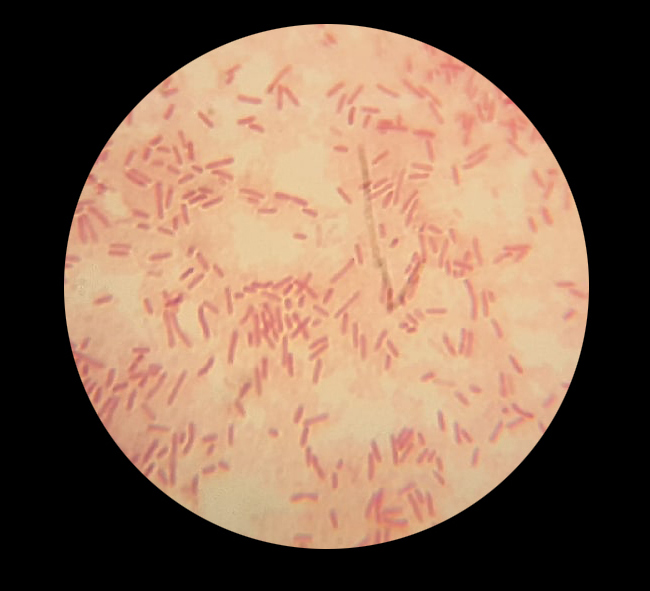
Salmonella enterica subsp. enterica serovar Typhimurium str. LT2

Gram-negativeRodMotileFacultative anaerobe

Kingdom

Pseudomonadati

Phylum

Pseudomonadota

Class

Gammaproteobacteria

Order

Enterobacterales

Family

Enterobacteriaceae

Genus

Salmonella

Description

Salmonella enterica subsp. enterica serovar Typhimurium str. LT2 is a Gram-negative, rod-shaped bacterium that thrives at mesophilic temperatures (20-45°C). This microbe is classified as a chemoheterotroph, utilizing organic compounds as both energy and carbon sources, making it dependent on the environment for its nutrients. As a facultative anaerobe, it can grow in both the presence and absence of oxygen, which allows it to colonize a variety of host environments. S. Typhimurium LT2 is known to inhabit the intestines of various hosts, including humans, birds, reptiles, and mammals. This adaptability to diverse hosts is a key feature of its pathogenicity, enabling it to infect a wide range of species and contribute to gastrointestinal diseases such as salmonellosis. The bacterium's virulence is often linked to its ability to invade intestinal epithelial cells, leading to inflammation and disrupting normal digestive processes. The microbe also possesses a remarkable genome, which has been sequenced to provide insights into its pathogenic mechanisms. For instance, it contains virulence factors such as Type III secretion systems, which play a crucial role in delivering effector proteins into host cells, promoting infection and evading the immune response. Furthermore, S. Typhimurium LT2 has been extensively studied as a model organism for understanding Salmonella pathogenesis and host interactions, contributing significantly to the field of microbiology. This strain is not only pivotal in research but also serves as a reminder of the importance of food safety practices, as it remains a common cause of foodborne illness worldwide, typically associated with the consumption of undercooked poultry, eggs, and contaminated produce.

Taxonomy

KingdomPseudomonadati
PhylumPseudomonadota
ClassGammaproteobacteria
OrderEnterobacterales
FamilyEnterobacteriaceae
GenusSalmonella
SpeciesSalmonella enterica
StrainLT2

Profile

Physiology
Gram staining propertiesNegative
ShapeRod
MobilityYes
Flagellar presenceYes
Number of membranes2
Image of Salmonella enterica subsp. enterica serovar Typhimurium str. LT2
Image source: Wikipedia/Wikimedia
Ecology, Host, and Life Cycle
Oxygen requirementsFacultative anaerobe
Optimal temperature37
Temperature rangeMesophilic
HabitatHostAssociated
Biotic relationshipFree living
Host(s)Homo sapiens
Cell arrangementPairs - Singles
SporulationNonsporulating
Energy sourceChemoorganotroph
PathogenicityYes

Genome Summary

Salmonella enterica subsp. enterica serovar Typhimurium str. LT2


Gene Summary

Adenine Count

22311 bp

Thymine Count

21718 bp

Guanine Count

25836 bp

Cytosine Count

24068 bp

Genome Length

93933 bp

Protein-coding Genes

83 genes

Non-Coding Genes

23 genes

# of Chromosomes/Plasmids

2

Genes

NameLocus TagUniProtStrandCoordinatesMolecular Weight
AttlNot AvailableNot Available+7559 - 7571Not Available
Non-functional integrasePSLT031Not Available+21466 - 2224828767.1
putative diguanylate cyclase/phosphodiesterasePSLT032Not Available+22257 - 2280819799.2
putative inner membrane proteinPSLT033Not Available+23477 - 2396216899.8
putative adhesinPSLT034Not Available+24682 - 2524220835.2
Transposase isec46, is605 familyPSLT035Not Available-25309 - 2565913502.8
Putative transposasePSLT036Not Available+25877 - 261409821.96
AttlNot AvailableNot Available+26173 - 26184Not Available
salmonella plasmid virulence: hydrophilic proteinPSLT037Not Available-26267 - 2691724846.2
salmonella plasmid virulence: hydrophilic proteinPSLT038Not Available-27178 - 2790327647.7

Displaying genes 1 – 10 of 4689 in total

Metabolites

1825 records
Metabolite IDMetabolite nameStructureCAS number
BASm00002502,5-didehydro-D-gluconateC6H7O7Chemical structure of 2,5-didehydro-D-gluconate53736-12-2
Average191.1156Da
Monoisotopic191.019177578Da
BASm00002532-oxopent-4-enoateC5H5O3Chemical structure of 2-oxopent-4-enoateNot available
Average113.093Da
Monoisotopic113.024417601Da
BASm00002603alpha,7alpha-dihydroxy-12-oxo-5beta-cholanateC24H37O5Chemical structure of 3alpha,7alpha-dihydroxy-12-oxo-5beta-cholanateNot available
Average405.556Da
Monoisotopic405.264647871Da
BASm0000274aldehydo-D-galacturonateC6H9O7Chemical structure of aldehydo-D-galacturonateNot available
Average193.132Da
Monoisotopic193.0353762Da
BASm00004283-oxoadipateC6H6O5Chemical structure of 3-oxoadipateNot available
Average158.11Da
Monoisotopic158.022620453Da
BASm00005166-deoxyerythronolide BC21H38O6Chemical structure of 6-deoxyerythronolide BNot available
Average386.5228Da
Monoisotopic386.2668389Da
BASm0000553biphenyl-2,3-diolC12H10O2Chemical structure of biphenyl-2,3-diolNot available
Average186.2066Da
Monoisotopic186.0680796Da
BASm0000592(S)-1-phenylethanolC8H10OChemical structure of (S)-1-phenylethanolNot available
Average122.1644Da
Monoisotopic122.0731649Da
BASm0000893crotonobetaineC7H13NO2Chemical structure of crotonobetaine927-89-9
Average143.1836Da
Monoisotopic143.0946287Da
BASm0000989GlycerolC3H8O3Chemical structure of Glycerol56-81-5
Average92.0938Da
Monoisotopic92.04734412Da

Displaying 1–10 of 1825 metabolites