Kingdom
Bacillati
Phylum
Bacillota
Class
Clostridia
Order
Eubacteriales
Family
Oscillospiraceae
Genus
Ruminococcus
Description
Taxonomy
| Kingdom | Bacillati |
|---|---|
| Phylum | Bacillota |
| Class | Clostridia |
| Order | Eubacteriales |
| Family | Oscillospiraceae |
| Genus | Ruminococcus |
| Species | Ruminococcus sp. |
| Strain | No strain |
Profile
| Physiology | |
|---|---|
| Gram staining properties | Positive |
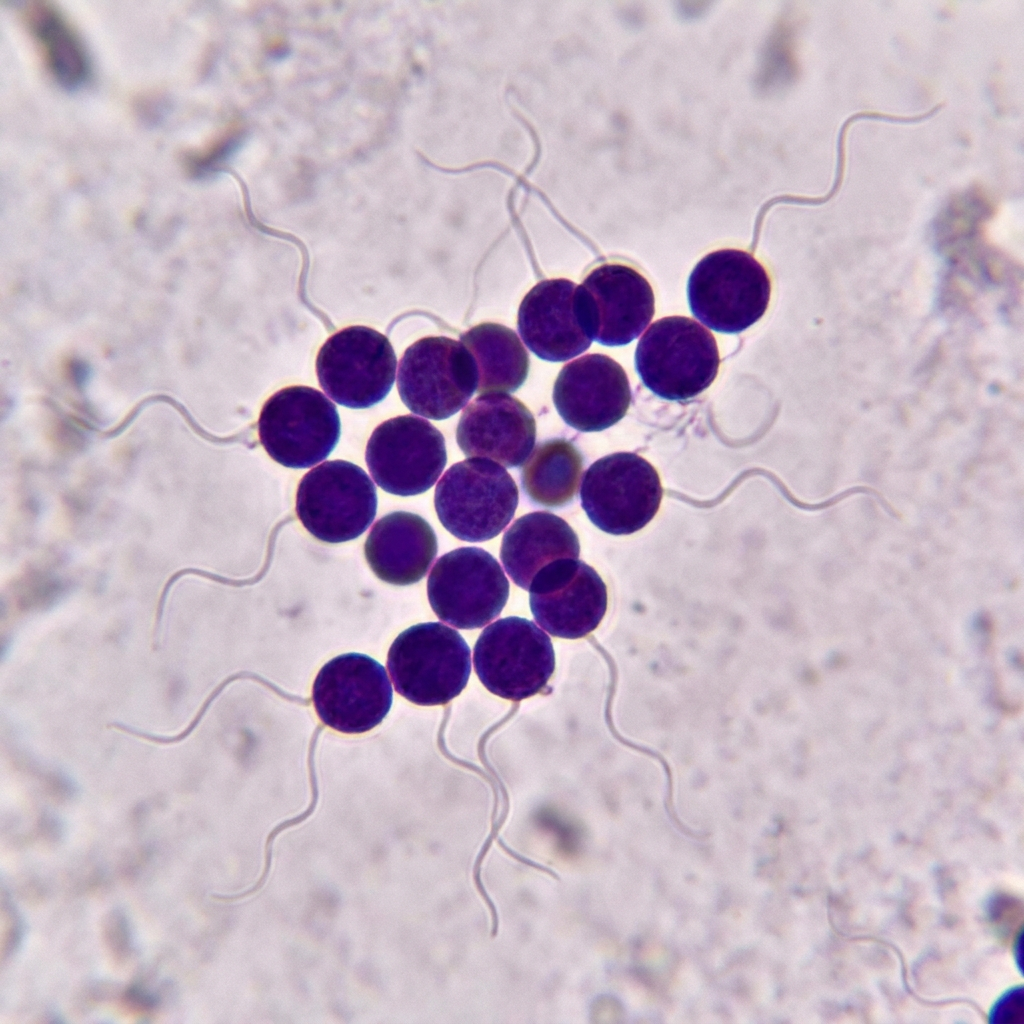
| Shape | Cocci |
| Mobility | No |
| Flagellar presence | Yes |
| Number of membranes | Not Available |
| Ecology, Host, and Life Cycle | |
|---|---|
| Oxygen requirements | Anaerobic |
| Optimal temperature | Not Available |
| Temperature range | Not Available |
| Habitat | Animal Intestinal Microflora |
| Biotic relationship | Not Available |
| Host(s) | Not Available |
| Cell arrangement | Not Available |
| Sporulation | Nonsporulating |
| Energy source | Chemoheterotroph |
| Pathogenicity | Not Available |
Genome Summary
Ruminococcus sp.
Accession NumberDMIF00000000.1
Gene Summary
Adenine Count
Not Available
Thymine Count
Not Available
Guanine Count
Not Available
Cytosine Count
Not Available
Genome Length
Not Available
Protein-coding Genes
Not Available
Non-Coding Genes
Not Available
# of Chromosomes/Plasmids
4
Genes
| Name | Locus Tag | UniProt | Strand | Coordinates | Molecular Weight |
|---|---|---|---|---|---|
| ygiq family radical sam protein | DCM18_09400 | Not Available | + | 1795382 - 1797346 | 73314.0 |
| mbl fold metallo-hydrolase | DCM18_09405 | Not Available | + | 1797259 - 1798227 | 34463.3 |
| duf3006 domain-containing protein | DCM18_09410 | Not Available | + | 1798224 - 1798439 | 8275.78 |
| nad(p)/fad-dependent oxidoreductase | DCM18_09415 | Not Available | + | 1798440 - 1799678 | 44234.2 |
| (d)cmp kinase | DCM18_09420 | Not Available | + | 1799783 - 1800454 | 25152.3 |
| (d)cmp kinase | DCM18_09425 | Not Available | + | 1800468 - 1800990 | 19981.2 |
| hypothetical protein | DCM18_09430 | Not Available | + | 1801148 - 1801366 | 8493.93 |
| bifunctional 4-hydroxy-3-methylbut-2-enyl diphosphate reductase/30s ribosomal protein s1 | DCM18_09435 | Not Available | + | 1801363 - 1803312 | 71189.9 |
| transcriptional regulator | DCM18_09440 | Not Available | + | 1803470 - 1803844 | 14226.4 |
| hypothetical protein | DCM18_09445 | Not Available | + | 1803928 - 1804467 | 20631.5 |
Pathways
0 pathways
No pathways found
No metabolic pathways have been associated with this bacterium yet.