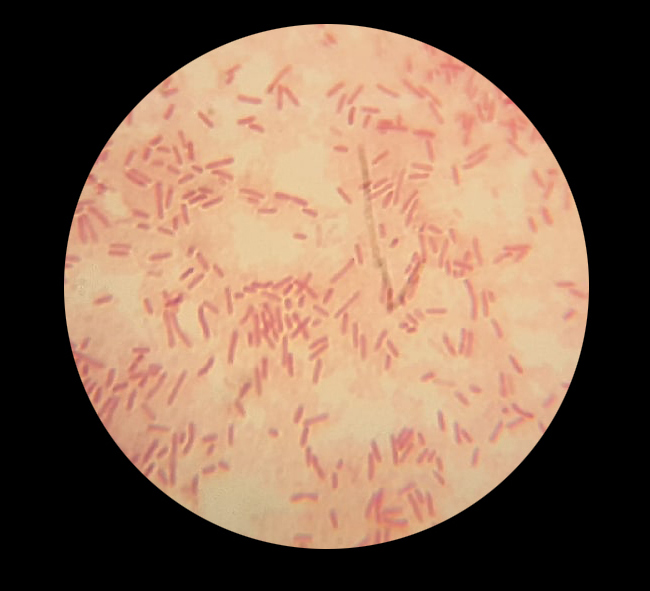
Salmonella enterica subsp. enterica serovar Typhimurium

Gram-negativeRodMotileFacultative anaerobe

Kingdom

Pseudomonadati

Phylum

Proteobacteria

Class

Gammaproteobacteria

Order

Enterobacterales

Family

Enterobacteriaceae

Genus

Salmonella

Description

Salmonella enterica subsp. enterica serovar Typhimurium is a Gram-negative, rod-shaped bacterium that thrives at mesophilic temperatures, classifying it as a facultative anaerobe and a chemoheterotroph. This microbe is capable of surviving in various body sites across multiple species, including the gastrointestinal tracts of mammals, birds, reptiles, and even humans, highlighting its ecological versatility. As a Gram-negative organism, S. Typhimurium possesses a thin peptidoglycan layer surrounded by an outer membrane containing lipopolysaccharides, which can contribute to its virulence and ability to evade the host immune response. Its rod shape allows for motility, facilitated by flagella, enabling efficient movement through viscous environments such as the intestinal lumen, where it often resides. Being mesophilic, it optimally grows at temperatures around 37°C, aligning with the internal body temperature of its warm-blooded hosts. As a facultative anaerobe, S. Typhimurium can generate energy both in the presence and absence of oxygen, demonstrating metabolic flexibility that enhances its survival in diverse environments. Its classification as a chemoheterotroph indicates that it derives energy and carbon from organic compounds, often utilizing nutrients found in the gut. This bacterium is notorious for its role in foodborne illnesses, commonly associated with the consumption of undercooked poultry, eggs, and other contaminated foods. Symptoms of infection can include diarrhea, fever, and abdominal cramps, often resulting from the organism's ability to invade intestinal epithelial cells and elicit strong immune responses. Additionally, S. Typhimurium has been extensively studied in laboratories, serving as a model organism for understanding bacterial pathogenesis and host interactions, as well as the development of antimicrobial strategies.

Taxonomy

KingdomPseudomonadati
PhylumProteobacteria
ClassGammaproteobacteria
OrderEnterobacterales
FamilyEnterobacteriaceae
GenusSalmonella
Speciesenterica
StrainTyphimurium

Profile

Physiology
Gram staining propertiesNegative
ShapeRod
MobilityYes
Flagellar presenceNot Available
Number of membranesNot Available
Image of Salmonella enterica subsp. enterica serovar Typhimurium
Image source: Wikipedia/Wikimedia
Ecology, Host, and Life Cycle
Oxygen requirementsFacultative anaerobe
Optimal temperature37
Temperature rangeMesophilic
HabitatHostAssociated
Biotic relationshipFree living
Host(s)Not Available
Cell arrangementPairs - Singles
SporulationNot Available
Energy sourceChemoorganotroph
PathogenicityNot Available

Gene Summary

Adenine Count

1165707 bp

Thymine Count

1177032 bp

Guanine Count

1292672 bp

Cytosine Count

1260276 bp

Genome Length

4895687 bp

Protein-coding Genes

4353 genes

Non-Coding Genes

343 genes

# of Chromosomes/Plasmids

10

Genes

NameLocus TagUniProtStrandCoordinatesMolecular Weight
AttlNot AvailableNot Available+368699 - 368745Not Available
IntegraseSTL3553_RS27830P04890-368759 - 36992244832.0
ExcisionaseSTL3553_RS25695P04889-369835 - 37014911533.8
Formate dehydrogenase n alpha subunitSTL3553_RS27835Not Available-370152 - 3702924887.25
Hypothetical proteinSTL3553_RS28060Q03544-370630 - 3707554702.75
Putative methylaseSTL3553_RS01670Not Available-370759 - 37123218069.9
Gene 21 proteinSTL3553_RS01675Not Available-371361 - 37168111797.8
Hypothetical proteinSTL3553_RS01680Not Available-371683 - 37198211456.9
Hypothetical proteinSTL3553_RS01685P76515-371979 - 37237714279.1
Hypothetical proteinSTL3553_RS01690P11192-372374 - 3725386374.91

Displaying genes 1 – 10 of 19841 in total

Metabolites

10 records
Metabolite IDMetabolite nameStructureCAS number
BASm0001865diphosphateHO7P2Chemical structure of diphosphateNot available
Average174.95Da
Monoisotopic174.9213971Da
BASm0002051D-fructoseC6H12O6Chemical structure of D-fructose57-48-7
Average180.1559Da
Monoisotopic180.0633881Da
BASm0003334aldehydo-D-ribose 5-phosphateC5H11O8PChemical structure of aldehydo-D-ribose 5-phosphateNot available
Average230.1098Da
Monoisotopic230.0191538Da
BASm0003389NADP(+)C21H25N7O17P3Chemical structure of NADP(+)Not available
Average740.386Da
Monoisotopic740.053624107Da
BASm0003701L-methionine (S)-S-oxideC5H11NO3SChemical structure of L-methionine (S)-S-oxide62697-73-8
Average165.21Da
Monoisotopic165.045964392Da
BASm0003983di-trans,octa-cis-undecaprenyl phosphateC55H89O4PChemical structure of di-trans,octa-cis-undecaprenyl phosphateNot available
Average845.288Da
Monoisotopic844.6509455Da
BASm0004386N-acetyl-alpha-D-glucosaminyl-di-trans,octa-cis-undecaprenyl diphosphateC63H103NO12P2Chemical structure of N-acetyl-alpha-D-glucosaminyl-di-trans,octa-cis-undecaprenyl diphosphateNot available
Average1128.461Da
Monoisotopic1127.696649Da
BASm0004885UDP-N-acetyl-alpha-D-mannosamineC17H25N3O17P2Chemical structure of UDP-N-acetyl-alpha-D-mannosamineNot available
Average605.34Da
Monoisotopic605.067017513Da
BASm0008132(8S)-3',8-cyclo-7,8-dihydroguanosine 5'-triphosphateC10H12N5O14P3Chemical structure of (8S)-3',8-cyclo-7,8-dihydroguanosine 5'-triphosphateNot available
Average519.15Da
Monoisotopic518.9615554Da
BASm0012597(6R)-10-formyltetrahydrofolateC20H21N7O7Chemical structure of (6R)-10-formyltetrahydrofolateNot available
Average471.431Da
Monoisotopic471.151343204Da

Displaying 1–10 of 10 metabolites