
Kingdom
Pseudomonadati
Phylum
Pseudomonadota
Class
Alphaproteobacteria
Order
Hyphomicrobiales
Family
Bartonellaceae
Genus
Bartonella
Description
Taxonomy
| Kingdom | Pseudomonadati |
|---|---|
| Phylum | Pseudomonadota |
| Class | Alphaproteobacteria |
| Order | Hyphomicrobiales |
| Family | Bartonellaceae |
| Genus | Bartonella |
| Species | Bartonella clarridgeiae |
| Strain | 73 |
Profile
| Physiology | |
|---|---|
| Gram staining properties | Negative |
| Shape | Bacilli |
| Mobility | Yes |
| Flagellar presence | Yes |
| Number of membranes | 2 |
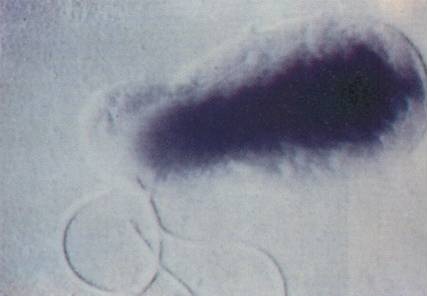
Image source: Wikipedia/Wikimedia
| Ecology, Host, and Life Cycle | |
|---|---|
| Oxygen requirements | Aerobic |
| Optimal temperature | Not Available |
| Temperature range | Mesophilic |
| Habitat | HostAssociated |
| Biotic relationship | Free living |
| Host(s) | cats and dogs |
| Cell arrangement | Not Available |
| Sporulation | Nonsporulating |
| Energy source | Not Available |
| Pathogenicity | Yes |
Gene Summary
Adenine Count
485648 bp
Thymine Count
493065 bp
Guanine Count
271592 bp
Cytosine Count
272438 bp
Genome Length
1522743 bp
Protein-coding Genes
1234 genes
Non-Coding Genes
51 genes
# of Chromosomes/Plasmids
1
Genes
| Name | Locus Tag | UniProt | Strand | Coordinates | Molecular Weight |
|---|---|---|---|---|---|
| 23s rrna (adenine(2503)-c(2))-methyltransferase rlmn | BARCL_RS00115 | Not Available | - | 20422 - 21657 | 46131.5 |
| invasion associated locus b family protein | BARCL_RS00120 | Not Available | - | 21698 - 22201 | 18635.7 |
| na+/h+ antiporter subunit c | BARCL_RS00125 | Not Available | - | 23011 - 23472 | 16457.8 |
| thioredoxin trxa | BARCL_RS00130 | Not Available | - | 24143 - 24466 | 11798.2 |
| double-strand break repair helicase adda | BARCL_RS00135 | Not Available | - | 24565 - 28023 | 132172.0 |
| double-strand break repair protein addb | BARCL_RS00140 | Not Available | - | 28020 - 31142 | 118212.0 |
| bifunctional trna (adenosine(37)-n6)-threonylcarbamoyltransferase complex atpase subunit type 1 tsae/phosphotransferase | BARCL_RS00145 | Not Available | - | 31340 - 32860 | 57837.2 |
| pas-domain containing protein | BARCL_RS00150 | Not Available | - | 32915 - 35110 | 83277.7 |
| adenosylhomocysteinase | BARCL_RS00155 | Not Available | - | 35405 - 36784 | 51141.6 |
| complex i ndufa9 subunit family protein | BARCL_RS00160 | Not Available | - | 37119 - 38117 | 36736.0 |
Pathways
0 pathways
No pathways found
No metabolic pathways have been associated with this bacterium yet.