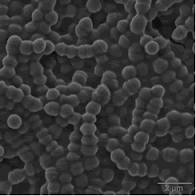
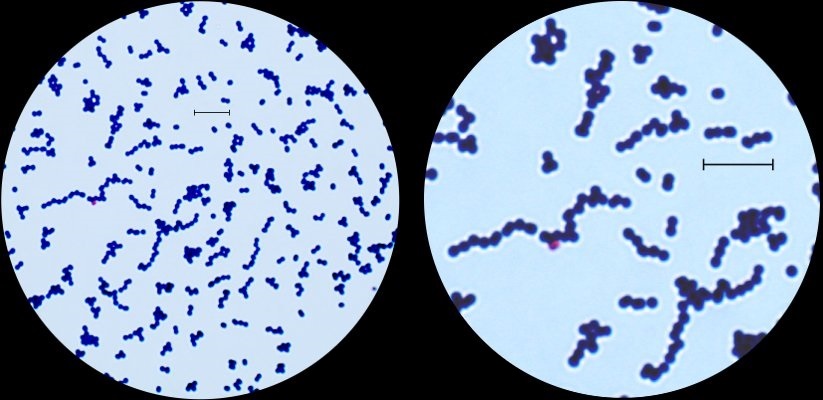
Streptococci are a diverse genus, infecting a barrage of different animals, including humans, with diseases ranging from strep throat to necrotizing fasciitis. They have come to public attention recently as antibiotic-resistant strains have started appearing and causing epidemics. In an effort to battle the evolution of these clever pathogens, researchers have sequenced the genomes of 11 different strains in 4 different species of Streptococcus.Streptococci are nonmotile, Gram-positive, nonsporeforming bacteria, that live in pairs or chains of varying length. They are characteristically round or ovoid in shape. Most Streptococci are facultative anaerobes, although some are obligate anaerobes. They usually require a complex culture medium in order to grow. Many streptococci imitate aspects of their host in order to escape detection. The capsule of Streptococcus pyogenes is chemically similar to that of it's host's connective tissue, and therefore, is nonantigenic, and it's cytoplasmic membrane has antigens similar to human cardiac skeletal and smooth muscle.Streptococci are a part of normal animal flora. Although some can cause diseases. The progression from latency to virulence is not well-understood, but the sequencing of the Streptococcus genomes is aiding researchers in understanding better the mechanisms of streptococci.Infections by Streptococci are separated into several categories, depending on the composition of their cell walls. Groups A and B are the most common and devastating human pathogens. Group A Streptococcus bacteria causes disease ranging from streptococcal sore throat (strep throat) to necrotizing fasciitis (flesh-eating disease). They can also cause scarlet fever, rheumatic fever, postpartum fever, and streptococcal toxic shock syndrome. S. pyogenes can be counted among their numbers as one of the major pathogens in group A streptococci. Necrotizing fasciitis is one of the most deadly strep infections, due to its rapid progression. It is an infection caused by a deadly strain of group A strep that attacks the deep layers of tissue (fascia). The strain is normally not so aggressive, and it is thought that its sudden virulence is triggered by lateral gene transfer by a bacteriophage.Streptococcal toxic shock syndrome is another serious strep infection that progresses very rapidly. It causes a dangerous drop in blood pressure, damage to the kidneys, liver, and lungs, and eventually shock. Due to its rapid progression, the damage is usually done before the disease can even be diagnosed, let alone treated.Group B streptococci cause life-threatening diseases in newborns, pregnant women, the elderly, and adults with compromised immune systems. Group B strep infections are different from other strep infections, in that the individual can be colonized by the bacteria before any symptoms are obvious. This means that people can carry the bacteria in their bodies but are not infected, and do not show any symptoms. Group B strep can be carried in the gastrointestinal tract, genital tract, or urinary tract, and only become dangerous when they invade the bloodstream.Among group B infections is pneumonia. Pneumonia can be caused by a barrage of different things including viruses and fungi, but is most commonly caused by Streptococcus pneumoniae (mentioned above in the genome section) also called pneumococcus, which is the only type of pneumonia for which there is a vaccine. S. pneumoniae are often present in healthy throats and only develop into a serious infection when the host's defenses are depleted due to such factors as old age, illness (i.e. AIDS), or malnutrition. Like necrotizing fasciitis and toxic shock syndrome, bacterial pneumonia progresses vary rapidly with a sudden onset of high fever. More seriously, the infection can become invasive and manifest itself as meningitis (an infection of the cerebrospinal fluid).Streptococci have been the focus of a lot of medical research because of newly emerging, antibiotic-resistant strains. Research into new antibiotics to treat the diseases and new vaccines to prevent them has escalated in recent years. And information on streptococci has increased with the sequencing of the genome of four different species of streptococci.(From http://microbewiki.kenyon.edu/index.php/Streptococcus) (MicrobeWiki: Streptococcus)