
Kingdom
Pseudomonadati
Phylum
Campylobacterota
Class
Epsilonproteobacteria
Order
Campylobacterales
Family
Helicobacteraceae
Genus
Helicobacter
Description
Taxonomy
| Kingdom | Pseudomonadati |
|---|---|
| Phylum | Campylobacterota |
| Class | Epsilonproteobacteria |
| Order | Campylobacterales |
| Family | Helicobacteraceae |
| Genus | Helicobacter |
| Species | Helicobacter pylori |
| Strain | SouthAfrica50 |
Profile
| Physiology | |
|---|---|
| Gram staining properties | Negative |
| Shape | Spirilla |
| Mobility | No |
| Flagellar presence | Yes |
| Number of membranes | 2 |
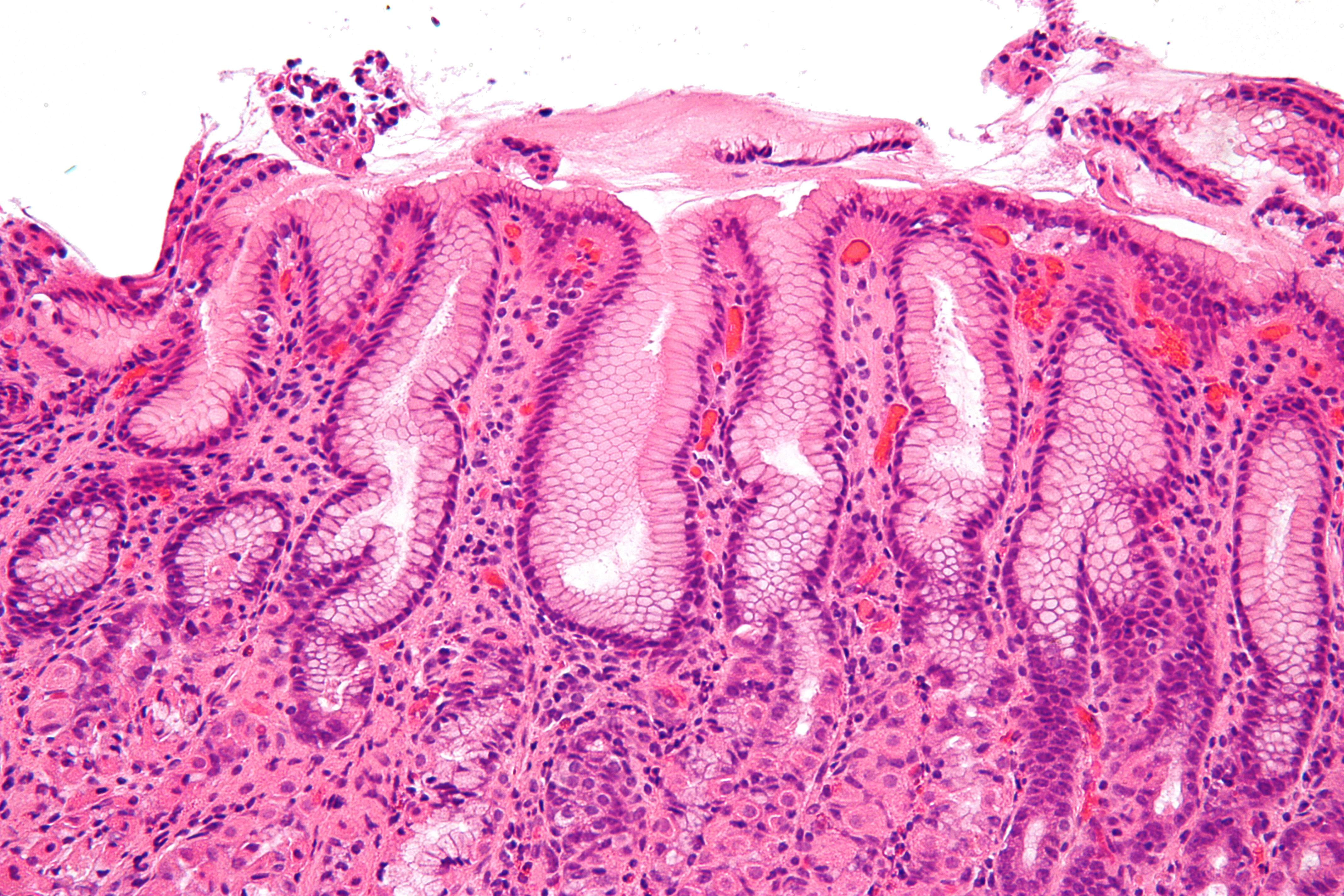
Image source: Wikipedia/Wikimedia
| Ecology, Host, and Life Cycle | |
|---|---|
| Oxygen requirements | Microaerophilic |
| Optimal temperature | 37 |
| Temperature range | Mesophilic |
| Habitat | HostAssociated |
| Biotic relationship | Free living |
| Host(s) | Not Available |
| Cell arrangement | Singles |
| Sporulation | Not Available |
| Energy source | Not Available |
| Pathogenicity | Not Available |
Gene Summary
Adenine Count
493282 bp
Thymine Count
488922 bp
Guanine Count
309943 bp
Cytosine Count
308021 bp
Genome Length
1600214 bp
Protein-coding Genes
1895 genes
Non-Coding Genes
43 genes
# of Chromosomes/Plasmids
1
Genes
| Name | Locus Tag | UniProt ID | Strand Orientation | Gene Start/End | Protein Molecular Weight |
|---|---|---|---|---|---|
| ycei-like domain protein | HPSA50_0398 | Not Available | Negative | 308136 - 308408 | 10121.4 |
| ycei-like domain protein | HPSA50_0399 | Not Available | Negative | 308432 - 308683 | 9458.4 |
| 5'-nucleotidase, lipoprotein e(p4) family | HPSA50_0400 | Not Available | Positive | 308808 - 309545 | 27792.9 |
| glycosyltransferase 9 family protein | HPSA50_0401 | Not Available | Positive | 309610 - 310668 | 40093.7 |
| anthranilate synthase component i | HPSA50_0402 | Not Available | Positive | 310909 - 312411 | 56456.1 |
| glutamine amidotransferase of anthranilate synthase/aminodeoxychorismate synthase family protein | HPSA50_0403 | Not Available | Positive | 312408 - 312995 | 21583.5 |
| anthranilate phosphoribosyltransferase | HPSA50_0404 | Not Available | Positive | 312992 - 313999 | 36778.9 |
| indole-3-glycerol phosphate synthase family protein | HPSA50_0405 | Not Available | Positive | 313992 - 314966 | 36542.5 |
| n-(5'phosphoribosyl)anthranilate (pra) isomerase family protein | HPSA50_0406 | Not Available | Positive | 314977 - 315351 | 13744.0 |
| tryptophan synthase, beta subunit | HPSA50_0407 | Not Available | Positive | 315353 - 316534 | 42696.5 |
Pathways
0 pathways
No pathways found
No metabolic pathways have been associated with this bacterium yet.
Health Effects
No health effects information available for this bacterium.



