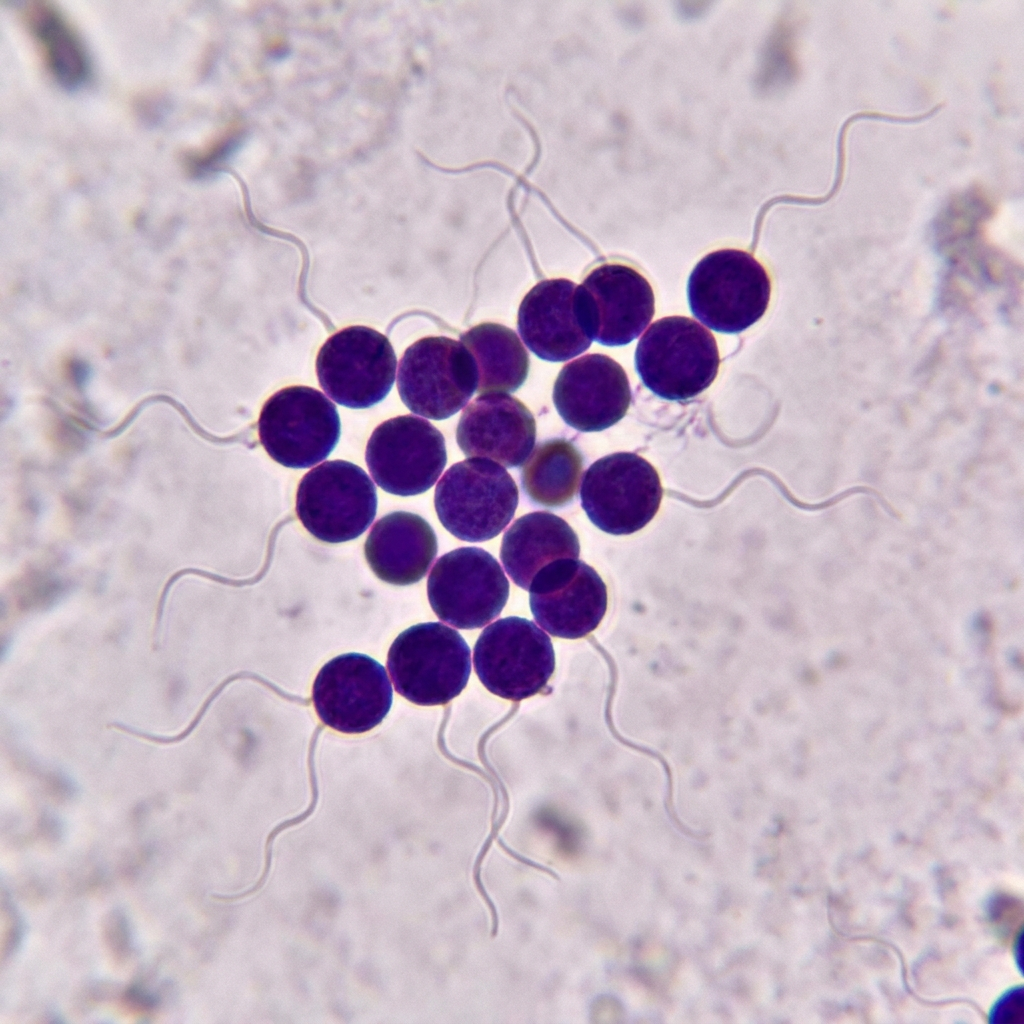
Micrococcus luteus NCTC 2665

Gram-positiveCocciNon-motileAerobe

Kingdom

Bacillati

Phylum

Actinomycetota

Class

Actinomycetes

Order

Micrococcales

Family

Micrococcaceae

Genus

Micrococcus

Description

Micrococcus luteus NCTC 2665 is a gram-positive, cocci-shaped microbe that thrives in mesophilic temperatures, classified as a chemoheterotroph, and can be found on all body sites in various species, including humans, animals, and plants, and is an obligate aerobe. The gram-positive characteristic indicates that the microbe has a thick peptidoglycan layer in its cell wall, which retains the crystal violet stain used in the gram staining procedure, appearing purple under a microscope. The cocci shape of Micrococcus luteus NCTC 2665 allows it to withstand various environmental stresses. As a mesophile, this microbe grows best in moderate temperatures, typically between 20-45°C, making it well-suited for survival in a wide range of environments.As a chemoheterotroph, Micrococcus luteus NCTC 2665 requires organic compounds for energy and carbon, which it obtains by breaking down complex molecules from its surroundings. This ability allows it to inhabit various body sites, from the skin and mucous membranes of humans and animals to the roots and leaves of plants. The microbe's presence on these sites is typically harmless, but it can become opportunistic under certain conditions. As an obligate aerobe, Micrococcus luteus NCTC 2665 requires oxygen to grow, which is why it is often found in well-oxygenated areas. This microbe has been used as a model organism in various scientific studies, particularly in the field of microbiology and biochemistry, due to its relatively simple structure and ease of cultivation. Micrococcus luteus NCTC 2665 produces yellow pigments, which have been found to have potential applications in the production of food coloring and cosmetics.

Taxonomy

KingdomBacillati
PhylumActinomycetota
ClassActinomycetes
OrderMicrococcales
FamilyMicrococcaceae
GenusMicrococcus
SpeciesMicrococcus luteus
StrainNCTC 2665

Profile

Physiology
Gram staining propertiesPositive
ShapeCocci
MobilityNo
Flagellar presenceYes
Number of membranes1
Image of Micrococcus luteus NCTC 2665
Ecology, Host, and Life Cycle
Oxygen requirementsAerobe
Optimal temperature29
Temperature rangeMesophilic
HabitatMultiple
Biotic relationshipFree living
Host(s)Not Available
Cell arrangementTetrads
SporulationNonsporulating
Energy sourceNot Available
PathogenicityNo

Genome Summary

Micrococcus luteus NCTC 2665

Accession NumberNC_012803.1

Gene Summary

Adenine Count

Not Available

Thymine Count

Not Available

Guanine Count

Not Available

Cytosine Count

Not Available

Genome Length

Not Available

Protein-coding Genes

Not Available

Non-Coding Genes

Not Available

# of Chromosomes/Plasmids

1

Genes

NameLocus TagUniProtStrandCoordinatesMolecular Weight
chromosomal replication initiator protein dnaaMLUT_RS11590Not Available+256 - 180356879.5
dna polymerase iii subunit betaMLUT_RS11595Not Available+2554 - 366939221.8
dna replication/repair protein recfMLUT_RS11600Not Available+3691 - 490543870.5
duf721 domain-containing proteinMLUT_RS11605Not Available+4898 - 546120292.2
dna topoisomerase (atp-hydrolyzing) subunit bMLUT_RS11610Not Available+5831 - 798178484.1
dna gyrase subunit aMLUT_RS11615Not Available+8050 - 1074699103.2
duf3566 domain-containing proteinMLUT_RS11620Not Available+10743 - 1124317074.0
Trna-ileNot AvailableNot Available+11344 - 11417Not Available
hypothetical proteinMLUT_RS23870Not Available+11476 - 116375497.31
Trna-alaNot AvailableNot Available+11649 - 11724Not Available

Displaying genes 1 – 10 of 2349 in total

Pathways

0 pathways

No pathways found

No metabolic pathways have been associated with this bacterium yet.

Metabolites

272 records
Metabolite IDMetabolite nameStructureCAS number
BASm0002826(2R)-3-phospho-glyceroyl phosphateC3H4O10P2Chemical structure of (2R)-3-phospho-glyceroyl phosphateNot available
Average262.005Da
Monoisotopic261.9301646Da
BASm0002858all-trans-undecaprenyl phosphateC55H89O4PChemical structure of all-trans-undecaprenyl phosphateNot available
Average845.288Da
Monoisotopic844.6509455Da
BASm0002909O-acetyl-L-homoserineC6H11NO4Chemical structure of O-acetyl-L-homoserine7540-67-2
Average161.1558Da
Monoisotopic161.0688078Da
BASm0002963meso-2,6-diaminoheptanedioateC7H14N2O4Chemical structure of meso-2,6-diaminoheptanedioate922-54-3
Average190.1971Da
Monoisotopic190.0953569Da
BASm0003070D-methionineC5H11NO2SChemical structure of D-methionine348-67-4
Average149.211Da
Monoisotopic149.0510493Da
BASm0003116all-trans-undecaprenyl diphosphateC55H89O7P2Chemical structure of all-trans-undecaprenyl diphosphateNot available
Average924.259Da
Monoisotopic923.6099999Da
BASm0003276S-(5-deoxy-D-ribos-5-yl)-L-homocysteineC9H17NO6SChemical structure of S-(5-deoxy-D-ribos-5-yl)-L-homocysteine15912-98-8
Average267.299Da
Monoisotopic267.077658Da
BASm0003296L-ribulose 5-phosphateC5H9O8PChemical structure of L-ribulose 5-phosphateNot available
Average228.094Da
Monoisotopic228.0046014Da
BASm0003333(2R)-3-phosphoglycerateC3H4O7PChemical structure of (2R)-3-phosphoglycerateNot available
Average183.033Da
Monoisotopic182.9711102Da
BASm0003346(2R)-2-phosphoglycerateC3H4O7PChemical structure of (2R)-2-phosphoglycerateNot available
Average183.033Da
Monoisotopic182.9711102Da

Displaying 21–30 of 272 metabolites