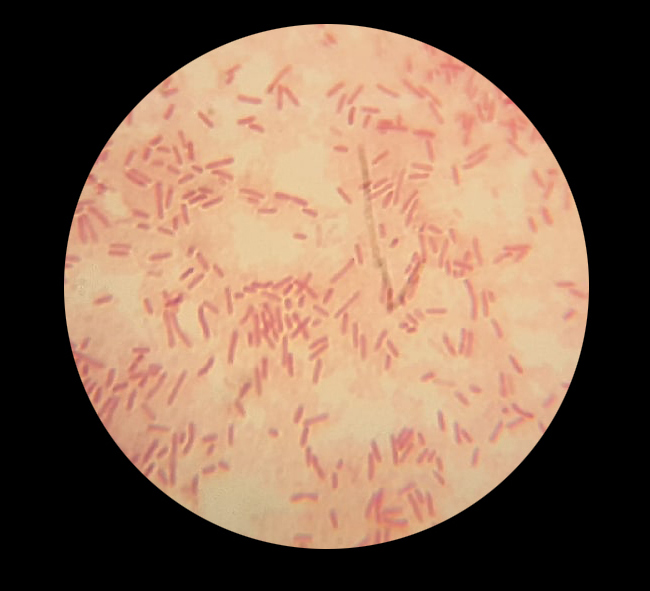
Salmonella enterica subsp. enterica serovar Newport str. SL254

Gram-negativeRodMotileFacultative anaerobe

Kingdom

Pseudomonadati

Phylum

Pseudomonadota

Class

Gammaproteobacteria

Order

Enterobacterales

Family

Enterobacteriaceae

Genus

Salmonella

Description

Salmonella enterica subsp. enterica serovar Newport str. SL254 is a gram-negative, rod-shaped bacterium that thrives at mesophilic temperatures, classified as a facultative anaerobe and a chemoheterotroph. This versatile microbe primarily resides in the intestines of warm-blooded animals, including humans, where it can cause gastrointestinal infections, but it can also be found in various environmental reservoirs such as soil, water, and contaminated food sources. As a gram-negative organism, Salmonella enterica possesses a thin peptidoglycan layer surrounded by an outer membrane rich in lipopolysaccharides, which contributes to its pathogenicity and ability to evade the host's immune response. The rod shape of the bacterium facilitates motility, allowing it to navigate through the viscous environment of the intestinal tract. Being mesophilic, it grows optimally at temperatures between 30°C and 37°C, aligning with the internal body temperature of its host.As a facultative anaerobe, SL254 can thrive in both aerobic and anaerobic environments, adapting its metabolic processes based on oxygen availability. Its classification as a chemoheterotroph indicates that it relies on organic compounds for carbon and energy, primarily deriving from the host’s nutrients during infections. This adaptability is critical for its survival in diverse environments and hosts. This particular strain of Salmonella enterica has garnered attention due to its antimicrobial resistance, particularly to commonly used antibiotics, posing challenges in clinical settings. Its ability to develop resistance mechanisms, such as efflux pumps and modified target sites, reflects a growing public health concern. Furthermore, serovar Newport has been implicated in several foodborne outbreaks, particularly associated with animal products such as poultry and beef, underscoring the importance of food safety measures in preventing transmission.

Taxonomy

KingdomPseudomonadati
PhylumPseudomonadota
ClassGammaproteobacteria
OrderEnterobacterales
FamilyEnterobacteriaceae
GenusSalmonella
SpeciesSalmonella enterica
StrainSL254

Profile

Physiology
Gram staining propertiesNegative
ShapeRod
MobilityYes
Flagellar presenceYes
Number of membranes2
Image of Salmonella enterica subsp. enterica serovar Newport str. SL254
Image source: Wikipedia/Wikimedia
Ecology, Host, and Life Cycle
Oxygen requirementsFacultative anaerobe
Optimal temperature37
Temperature rangeMesophilic
HabitatMultiple
Biotic relationshipFree living
Host(s)Homo sapiens
Cell arrangementPairs - Singles
SporulationNonsporulating
Energy sourceChemoorganotroph
PathogenicityYes

Genome Summary

Salmonella enterica subsp. enterica serovar Newport str. SL254


Gene Summary

Adenine Count

1154071 bp

Thymine Count

1152734 bp

Guanine Count

1260889 bp

Cytosine Count

1259947 bp

Genome Length

4827641 bp

Protein-coding Genes

4294 genes

Non-Coding Genes

440 genes

# of Chromosomes/Plasmids

3

Genes

NameLocus TagUniProtStrandCoordinatesMolecular Weight
Hypothetical proteinSNSL254_RS06500Not Available+1148171 - 114876722457.5
Hypothetical proteinSNSL254_RS06505Not Available+1148764 - 114905711070.3
duf1133 family proteinSNSL254_RS06510Not Available+1149054 - 114963222014.0
Hypothetical proteinSNSL254_RS06515Not Available+1150025 - 11502136897.01
Phage 21-like group ii holinSNSL254_RS06520Not Available+1150416 - 115071811176.5
EndolysinSNSL254_RS06525Not Available+1150696 - 115123519860.7
Outer membrane lytic protein rzSNSL254_RS06530Not Available+1151553 - 115200816656.8
Terminase small subunitSNSL254_RS06535Not Available+1152509 - 115313823603.2
Terminase large subunitSNSL254_RS06540Not Available+1153141 - 115476361562.2
Putative portal proteinSNSL254_RS06545Not Available+1154763 - 115623254804.2

Displaying genes 91 – 100 of 4936 in total

Metabolites

39 records
Metabolite IDMetabolite nameStructureCAS number
BASm00002502,5-didehydro-D-gluconateC6H7O7Chemical structure of 2,5-didehydro-D-gluconate53736-12-2
Average191.1156Da
Monoisotopic191.019177578Da
BASm00008763-hydroxypyruvateC3H3O4Chemical structure of 3-hydroxypyruvateNot available
Average103.054Da
Monoisotopic103.003682157Da
BASm0001330N-acetyl-D-hexosamineC8H15NO6Chemical structure of N-acetyl-D-hexosamineNot available
Average221.209Da
Monoisotopic221.089937207Da
BASm0001865diphosphateHO7P2Chemical structure of diphosphateNot available
Average174.95Da
Monoisotopic174.9213971Da
BASm0001885Tetra-mu3-sulfido-tetrairon(1+)Fe4S4Chemical structure of Tetra-mu3-sulfido-tetrairon(1+)Not available
Average351.62Da
Monoisotopic351.62748Da
BASm0001921(S)-3-methyl-2-oxopentanoateC6H9O3Chemical structure of (S)-3-methyl-2-oxopentanoate1460-34-0
Average129.1339Da
Monoisotopic129.0551692Da
BASm0002002glyoxylateC2HO3Chemical structure of glyoxylateNot available
Average73.0275Da
Monoisotopic72.9925689Da
BASm0002909O-acetyl-L-homoserineC6H11NO4Chemical structure of O-acetyl-L-homoserine7540-67-2
Average161.1558Da
Monoisotopic161.0688078Da
BASm0002963meso-2,6-diaminoheptanedioateC7H14N2O4Chemical structure of meso-2,6-diaminoheptanedioate922-54-3
Average190.1971Da
Monoisotopic190.0953569Da
BASm0003107S-inosyl-L-homocysteineC14H19N5O6SChemical structure of S-inosyl-L-homocysteineNot available
Average385.396Da
Monoisotopic385.1056041Da

Displaying 1–10 of 39 metabolites