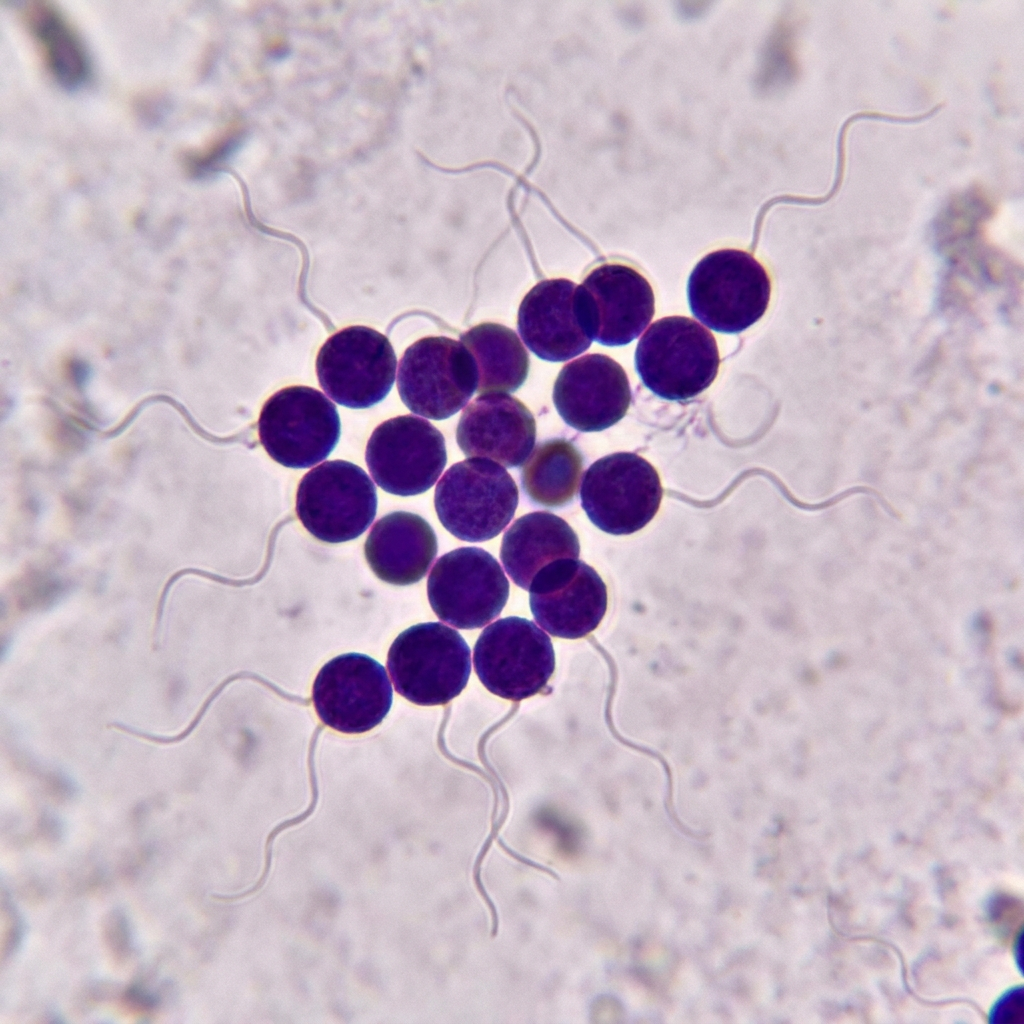
Lactococcus lactis subsp. lactis Il1403

Gram-positiveCocciNon-motileFacultative anaerobe

Kingdom

Bacillati

Phylum

Bacillota

Class

Bacilli

Order

Lactobacillales

Family

Streptococcaceae

Genus

Lactococcus

Description

Lactococcus lactis subsp. lactis Il1403 is a Gram-positive, spherical-shaped microbe that thrives in mesophilic temperatures, categorizing it as a chemoheterotroph, and can be found in various body sites of numerous species, including the gastrointestinal tract of humans, animals, and even plants. As a facultative anaerobe, it can survive in both aerobic and anaerobic environments, making it a versatile microorganism.The Gram-positive characteristic is due to the presence of a thick peptidoglycan layer in its cell wall, which retains the crystal violet stain during the Gram staining procedure. Its spherical shape is a result of the rigid cell wall that provides structural support and maintains the cell's shape. The mesophilic temperature preference allows Lactococcus lactis subsp. lactis Il1403 to grow best in temperatures between 20-40°C, making it suitable for various industrial and environmental applications. As a chemoheterotroph, Lactococcus lactis subsp. lactis Il1403 relies on external sources of energy and organic compounds, such as sugars and amino acids, to sustain its growth and metabolic activities. Its ability to inhabit various body sites, including the gut and skin of different species, highlights its adaptability and potential to interact with diverse host environments. The facultative anaerobic nature of Lactococcus lactis subsp. lactis Il1403 enables it to adjust its metabolic pathways according to the availability of oxygen, allowing it to thrive in a range of ecosystems. Lactococcus lactis subsp. lactis Il1403 has been extensively studied for its potential in biotechnology and food production, particularly in the production of fermented dairy products, such as cheese and yogurt, due to its ability to ferment lactose and produce lactic acid. Its genome has been fully sequenced, providing valuable insights into its genetic makeup and metabolic capabilities, and has been used as a model organism to explore the intricacies of microbial physiology and genetics.

Taxonomy

KingdomBacillati
PhylumBacillota
ClassBacilli
OrderLactobacillales
FamilyStreptococcaceae
GenusLactococcus
SpeciesLactococcus lactis
StrainIl1403

Profile

Physiology
Gram staining propertiesPositive
ShapeCocci
MobilityNo
Flagellar presenceYes
Number of membranes1
Image of Lactococcus lactis subsp. lactis Il1403
Ecology, Host, and Life Cycle
Oxygen requirementsFacultative anaerobe
Optimal temperature40
Temperature rangeMesophilic
HabitatMultiple
Biotic relationshipFree living
Host(s)Not Available
Cell arrangementNot Available
SporulationNonsporulating
Energy sourceNot Available
PathogenicityNo

Genome Summary

Lactococcus lactis subsp. lactis Il1403

Accession NumberNC_002662.1

Gene Summary

Adenine Count

Not Available

Thymine Count

Not Available

Guanine Count

Not Available

Cytosine Count

Not Available

Genome Length

Not Available

Protein-coding Genes

Not Available

Non-Coding Genes

Not Available

# of Chromosomes/Plasmids

1

Genes

NameLocus TagUniProtStrandCoordinatesMolecular Weight
AttlNot AvailableNot Available+28459 - 28476Not Available
Hypothetical proteinL_RS00180Not Available-35516 - 3583912573.9
Hypothetical proteinL_RS00185Not Available-35864 - 3627415906.2
TerminaseL_RS00190Not Available-36271 - 3671416319.2
Hypothetical proteinL_RS00195Not Available-36847 - 3742821500.4
HelicaseL_RS00200Not Available-37664 - 3929262325.2
Hypothetical proteinL_RS00205Not Available-39303 - 4009729879.3
Hypothetical proteinL_RS00210Not Available-40101 - 4043012432.9
Hypothetical proteinL_RS00215Not Available-40417 - 406117492.8
Hypothetical proteinL_RS00220Not Available-40859 - 410988867.58

Displaying genes 1 – 10 of 2421 in total

Pathways

0 pathways

No pathways found

No metabolic pathways have been associated with this bacterium yet.

Metabolites

300 records
Metabolite IDMetabolite nameStructureCAS number
BASm0000237(R)-4'-phosphopantothenateC9H18NO8PChemical structure of (R)-4'-phosphopantothenateNot available
Average299.2149Da
Monoisotopic299.0770031Da
BASm00002512-dehydropantoateC6H9O4Chemical structure of 2-dehydropantoateNot available
Average145.1333Da
Monoisotopic145.050083776Da
BASm0000274aldehydo-D-galacturonateC6H9O7Chemical structure of aldehydo-D-galacturonateNot available
Average193.132Da
Monoisotopic193.0353762Da
BASm0000377(S)-malateC4H4O5Chemical structure of (S)-malateNot available
Average132.0716Da
Monoisotopic132.005873238Da
BASm0000387(6R)-5,10-methylene-5,6,7,8-tetrahydrofolateC20H21N7O6Chemical structure of (6R)-5,10-methylene-5,6,7,8-tetrahydrofolateNot available
Average455.432Da
Monoisotopic455.1564286Da
BASm0000893crotonobetaineC7H13NO2Chemical structure of crotonobetaine927-89-9
Average143.1836Da
Monoisotopic143.0946287Da
BASm0000989GlycerolC3H8O3Chemical structure of Glycerol56-81-5
Average92.0938Da
Monoisotopic92.04734412Da
BASm0001111keto-D-tagaturonateC6H9O7Chemical structure of keto-D-tagaturonateNot available
Average193.132Da
Monoisotopic193.0353762Da
BASm0001167triphosphateO10P3Chemical structure of triphosphate14127-68-5
Average252.9153Da
Monoisotopic252.8704308Da
BASm00012442-succinylbenzoateC11H8O5Chemical structure of 2-succinylbenzoate27415-09-04
Average220.181Da
Monoisotopic220.038270517Da

Displaying 1–10 of 300 metabolites