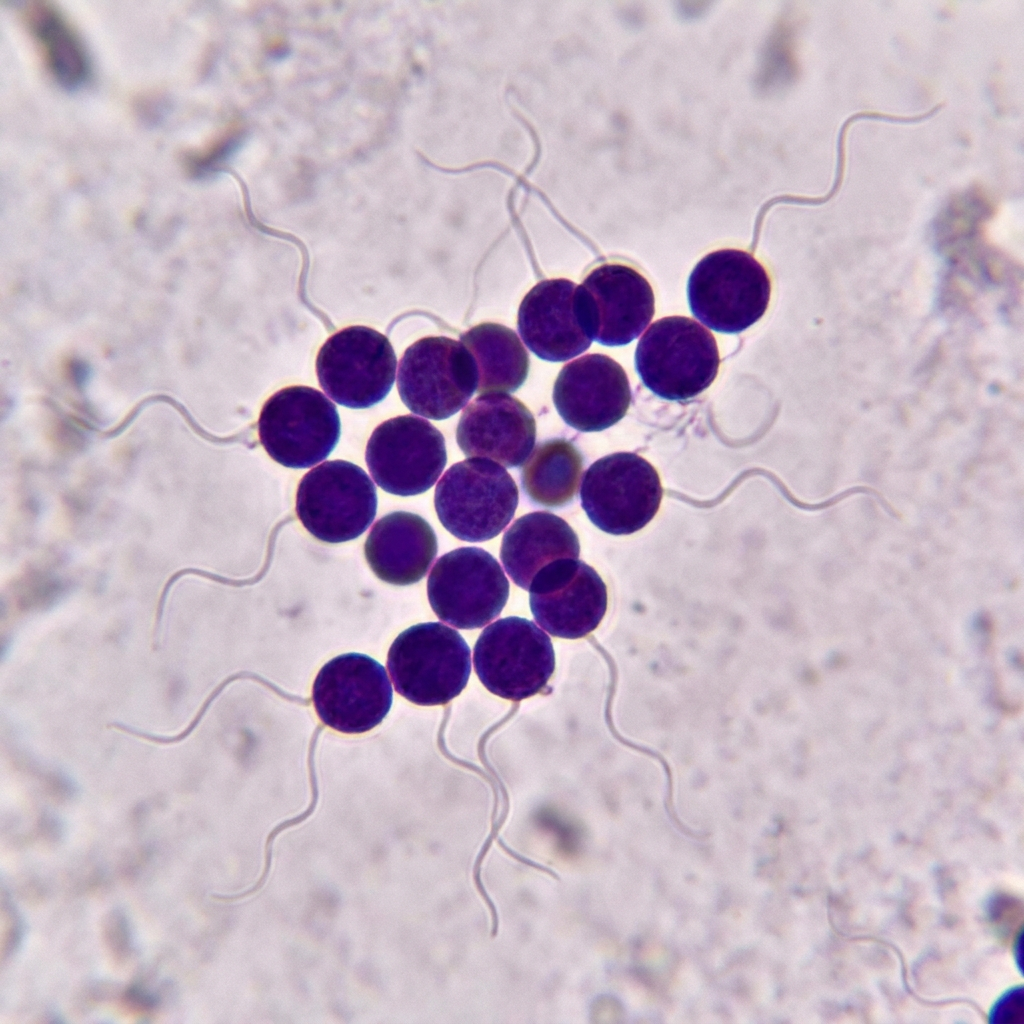
Leuconostoc mesenteroides subsp. mesenteroides ATCC 8293

Gram-positiveCocciNon-motileFacultative anaerobe

Kingdom

Bacillati

Phylum

Bacillota

Class

Bacilli

Order

Lactobacillales

Family

Lactobacillaceae

Genus

Leuconostoc

Description

Leuconostoc mesenteroides subsp. mesenteroides ATCC 8293 is a gram-positive, cocci-shaped microbe that thrives in mesophilic temperatures, categorized as a chemoheterotroph, and can be found in various body sites of numerous species, including the gastrointestinal tract, oral cavity, and skin of humans, animals, and even plants. As a facultative anaerobe, this microbe can survive in both aerobic and anaerobic environments, allowing it to adapt to different conditions.The gram-positive characteristic of Leuconostoc mesenteroides subsp. mesenteroides ATCC 8293 indicates the presence of a thick peptidoglycan layer in its cell wall, providing resistance to certain environmental stresses. Its cocci shape enables it to withstand various physical forces and promotes cell-to-cell interaction. As a mesophilic microbe, it grows optimally at moderate temperatures, typically between 20-45°C, making it well-suited for a wide range of environments. As a chemoheterotroph, Leuconostoc mesenteroides subsp. mesenteroides ATCC 8293 relies on organic compounds for energy and carbon, breaking down complex molecules into simpler ones for nutrition. This metabolic versatility allows it to inhabit diverse ecosystems, from soil and water to the guts of various organisms. The microbe's ability to thrive in different body sites of various species is a testament to its adaptability and potential for symbiotic relationships. Leuconostoc mesenteroides subsp. mesenteroides ATCC 8293 plays a significant role in the production of fermented foods, such as sauerkraut, kefir, and kimchi, where it contributes to the development of flavor, texture, and nutritional content. Its ability to produce antimicrobial compounds, like bacteriocins, also makes it a subject of research for potential applications in food preservation and biomedical fields.

Taxonomy

KingdomBacillati
PhylumBacillota
ClassBacilli
OrderLactobacillales
FamilyLactobacillaceae
GenusLeuconostoc
SpeciesLeuconostoc mesenteroides
StrainATCC 8293

Profile

Physiology
Gram staining propertiesPositive
ShapeCocci
MobilityNo
Flagellar presenceYes
Number of membranes1
Image of Leuconostoc mesenteroides subsp. mesenteroides ATCC 8293
Ecology, Host, and Life Cycle
Oxygen requirementsFacultative anaerobe
Optimal temperature20
Temperature rangeMesophilic
HabitatMultiple
Biotic relationshipFree living
Host(s)Not Available
Cell arrangementSingles - Chains - Pairs
SporulationNot Available
Energy sourceNot Available
PathogenicityNo

Genome Summary

Leuconostoc mesenteroides subsp. mesenteroides ATCC 8293

Accession NumberNC_008531.1

Gene Summary

Adenine Count

Not Available

Thymine Count

Not Available

Guanine Count

Not Available

Cytosine Count

Not Available

Genome Length

Not Available

Protein-coding Genes

Not Available

Non-Coding Genes

Not Available

# of Chromosomes/Plasmids

1

Genes

NameLocus TagUniProtStrandCoordinatesMolecular Weight
AttlNot AvailableNot Available+1608537 - 1608552Not Available
2_nc_021803: metallo-beta-lactamase domain-containing proteinLEUM_RS07940Not Available+1620143 - 162182561829.4
hypothetical proteinLEUM_RS07945Not Available-1622387 - 162264410310.4
hypothetical proteinLEUM_RS07950Not Available+1622758 - 162323418373.9
hypothetical proteinLEUM_RS07955Not Available+1623241 - 162383722935.8
Hol44LEUM_RS10890Not Available-1623878 - 16240606339.56
Putative endolysinLEUM_RS07965Not Available-1624192 - 162528339732.6
hypothetical proteinLEUM_RS07970Not Available-1625287 - 16255118553.37
Hypothetical proteinLEUM_RS07975Not Available-1625529 - 162633528691.9
Gp16LEUM_RS07980Not Available-1626347 - 162743840723.4

Displaying genes 1 – 10 of 2054 in total

Pathways

0 pathways

No pathways found

No metabolic pathways have been associated with this bacterium yet.

Metabolites

196 records
Metabolite IDMetabolite nameStructureCAS number
BASm00034704-(phosphooxy)-L-threonineC4H8NO7PChemical structure of 4-(phosphooxy)-L-threonineNot available
Average213.083Da
Monoisotopic213.0049358Da
BASm0003491(2S)-2-acetolactateC5H7O4Chemical structure of (2S)-2-acetolactateNot available
Average131.108Da
Monoisotopic131.0349823Da
BASm00035255-[(5-phospho-1-deoxy-D-ribulos-1-ylimino)methylamino]-1-(5-phospho-beta-D-ribosyl)imidazole-4-carboxamideC15H21N5O15P2Chemical structure of 5-[(5-phospho-1-deoxy-D-ribulos-1-ylimino)methylamino]-1-(5-phospho-beta-D-ribosyl)imidazole-4-carboxamideNot available
Average573.303Da
Monoisotopic573.0531333Da
BASm0003537(R)-3-hydroxy-2-oxo-4-phosphooxybutanoateC4H4O8PChemical structure of (R)-3-hydroxy-2-oxo-4-phosphooxybutanoateNot available
Average211.043Da
Monoisotopic210.9660248Da
BASm00036954-phospho-D-erythronateC4H6O8PChemical structure of 4-phospho-D-erythronateNot available
Average213.059Da
Monoisotopic212.9816749Da
BASm0003696N-acetyl-(2S,6S)-2,6-diaminoheptanedioateC9H15N2O5Chemical structure of N-acetyl-(2S,6S)-2,6-diaminoheptanedioateNot available
Average231.229Da
Monoisotopic231.098645171Da
BASm00037365-enolpyruvoyl-6-hydroxy-2-succinyl-cyclohex-3-ene-1-carboxylateC14H13O9Chemical structure of 5-enolpyruvoyl-6-hydroxy-2-succinyl-cyclohex-3-ene-1-carboxylateNot available
Average325.251Da
Monoisotopic325.057602738Da
BASm0003763(1S,2R)-1-C-(indol-3-yl)glycerol 3-phosphateC11H12NO6PChemical structure of (1S,2R)-1-C-(indol-3-yl)glycerol 3-phosphateNot available
Average285.1898Da
Monoisotopic285.0402236Da
BASm0003810propanoyl phosphateC3H5O5PChemical structure of propanoyl phosphate121-69-7
Average152.043Da
Monoisotopic151.9885574Da
BASm0003915Mur2Ac(oyl-L-Ala-gamma-D-Glu-L-Lys-D-Ala-D-Ala)-di-trans,octa-cis-undecaprenyl diphosphateC86H140N7O21P2Chemical structure of Mur2Ac(oyl-L-Ala-gamma-D-Glu-L-Lys-D-Ala-D-Ala)-di-trans,octa-cis-undecaprenyl diphosphateNot available
Average1670.043Da
Monoisotopic1668.959399292Da

Displaying 41–50 of 196 metabolites