Kingdom
Bacillati
Phylum
Bacillota
Class
Bacilli
Order
Lactobacillales
Family
Enterococcaceae
Genus
Melissococcus
Description
Taxonomy
| Kingdom | Bacillati |
|---|---|
| Phylum | Bacillota |
| Class | Bacilli |
| Order | Lactobacillales |
| Family | Enterococcaceae |
| Genus | Melissococcus |
| Species | Melissococcus plutonius |
| Strain | No strain |
Profile
| Physiology | |
|---|---|
| Gram staining properties | Positive |
| Shape | Cocci |
| Mobility | No |
| Flagellar presence | Yes |
| Number of membranes | Not Available |
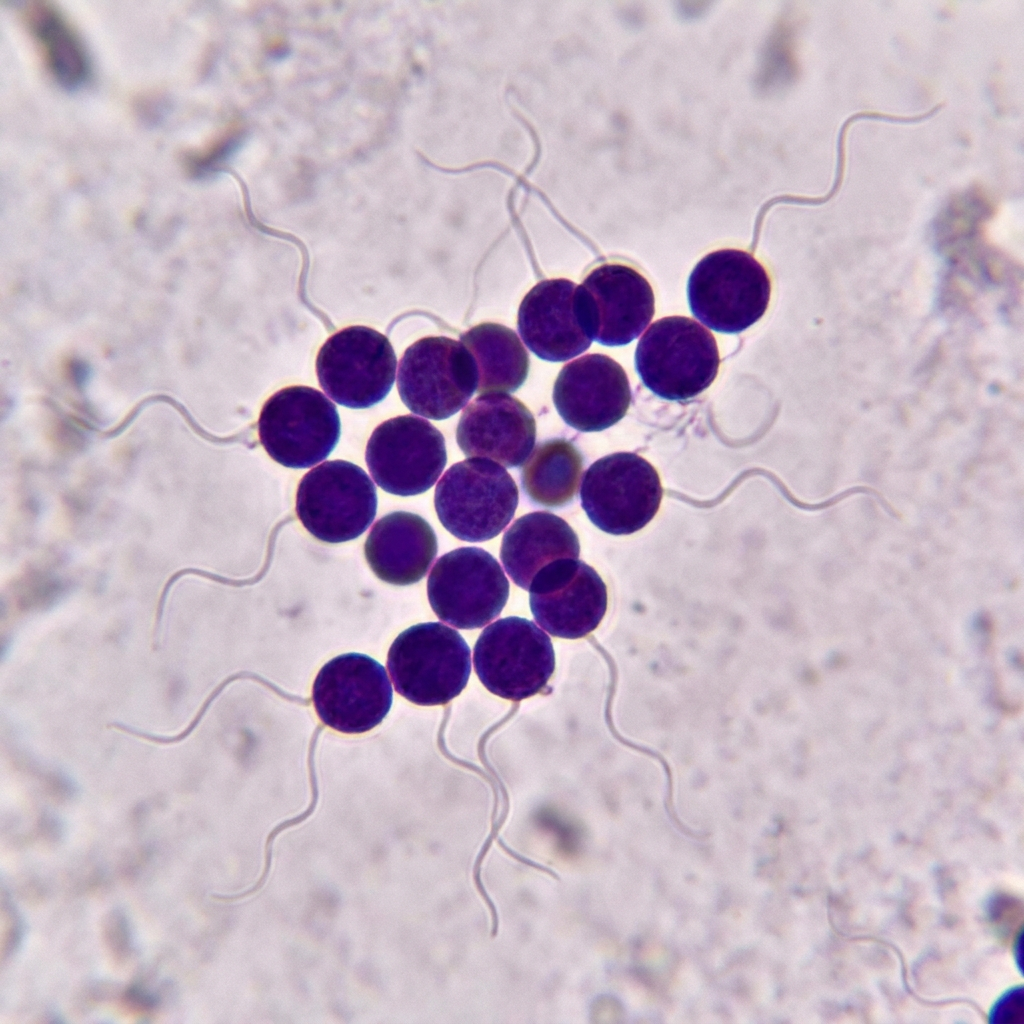
| Ecology, Host, and Life Cycle | |
|---|---|
| Oxygen requirements | Anaerobic |
| Optimal temperature | 35 |
| Temperature range | Mesophilic |
| Habitat | Multiple |
| Biotic relationship | Not Available |
| Host(s) | Not Available |
| Cell arrangement | Not Available |
| Sporulation | Nonsporulating |
| Energy source | Chemoheterotroph |
| Pathogenicity | A. mellifera |
Genome Summary
Melissococcus plutonius
Accession NumberNZ_AP018492.1
Gene Summary
Adenine Count
637346 bp
Thymine Count
629327 bp
Guanine Count
292533 bp
Cytosine Count
288601 bp
Genome Length
1847807 bp
Protein-coding Genes
1517 genes
Non-Coding Genes
90 genes
# of Chromosomes/Plasmids
1
Genes
| Name | Locus Tag | UniProt | Strand | Coordinates | Molecular Weight |
|---|---|---|---|---|---|
| murr/rpir family transcriptional regulator | DAT869_RS07535 | Not Available | + | 1744741 - 1745592 | 32021.2 |
| formate/nitrite transporter family protein | DAT869_RS07540 | Not Available | - | 1746223 - 1748181 | 69974.9 |
| n-acetylmuramic acid 6-phosphate etherase | DAT869_RS07545 | Not Available | - | 1748194 - 1749084 | 32280.2 |
| duf871 domain-containing protein | DAT869_RS07550 | Not Available | - | 1749086 - 1750138 | 40102.3 |
| pts ascorbate transporter subunit iic | DAT869_RS07555 | Not Available | - | 1750723 - 1752087 | 47787.3 |
| pts sugar transporter subunit iib | DAT869_RS07560 | Not Available | - | 1752117 - 1752398 | 9873.05 |
| bglg family transcription antiterminator | DAT869_RS07565 | Not Available | - | 1752398 - 1754452 | 79893.5 |
| hypothetical protein | DAT869_RS07570 | Not Available | - | 1755008 - 1755322 | 12228.5 |
| hypothetical protein | DAT869_RS07575 | Not Available | - | 1755566 - 1756312 | 27492.0 |
| 23s rrna (pseudouridine(1915)-n(3))-methyltransferase rlmh | DAT869_RS07580 | Not Available | - | 1757097 - 1757576 | 18239.5 |
Pathways
0 pathways
No pathways found
No metabolic pathways have been associated with this bacterium yet.