Kingdom
Bacillati
Phylum
Bacillota
Class
Bacilli
Order
Lactobacillales
Family
Enterococcaceae
Genus
Melissococcus
Description
Taxonomy
| Kingdom | Bacillati |
|---|---|
| Phylum | Bacillota |
| Class | Bacilli |
| Order | Lactobacillales |
| Family | Enterococcaceae |
| Genus | Melissococcus |
| Species | Melissococcus plutonius |
| Strain | No strain |
Profile
| Physiology | |
|---|---|
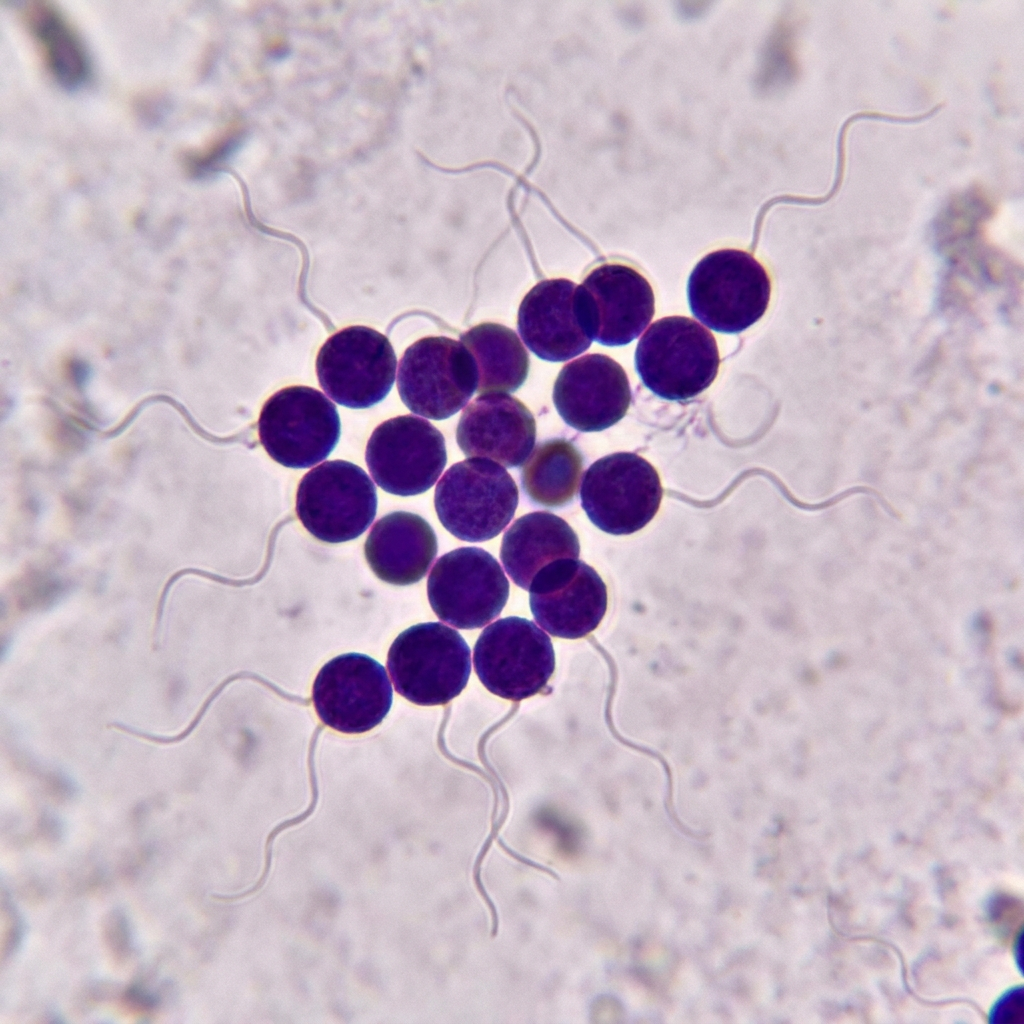
| Gram staining properties | Positive |
| Shape | Cocci |
| Mobility | No |
| Flagellar presence | Yes |
| Number of membranes | Not Available |
| Ecology, Host, and Life Cycle | |
|---|---|
| Oxygen requirements | Anaerobic |
| Optimal temperature | 35 |
| Temperature range | Mesophilic |
| Habitat | Multiple |
| Biotic relationship | Not Available |
| Host(s) | Not Available |
| Cell arrangement | Not Available |
| Sporulation | Nonsporulating |
| Energy source | Chemoheterotroph |
| Pathogenicity | A. mellifera |
Genome Summary
Melissococcus plutonius
Accession NumberNZ_AP018492.1
Gene Summary
Adenine Count
637346 bp
Thymine Count
629327 bp
Guanine Count
292533 bp
Cytosine Count
288601 bp
Genome Length
1847807 bp
Protein-coding Genes
1517 genes
Non-Coding Genes
90 genes
# of Chromosomes/Plasmids
1
Genes
| Name | Locus Tag | UniProt | Strand | Coordinates | Molecular Weight |
|---|---|---|---|---|---|
| xylose isomerase | DAT869_RS07390 | Not Available | - | 1705923 - 1707227 | 49680.5 |
| rok family transcriptional regulator | DAT869_RS07395 | Not Available | + | 1707375 - 1708535 | 43326.4 |
| hypothetical protein | DAT869_RS07400 | Not Available | - | 1708867 - 1710540 | 64515.1 |
| abc transporter atp-binding protein | DAT869_RS07405 | Not Available | - | 1710537 - 1711427 | 33337.3 |
| tagatose-bisphosphate aldolase | DAT869_RS07410 | Not Available | - | 1711656 - 1712639 | 36316.6 |
| tagatose-6-phosphate kinase | DAT869_RS07415 | Not Available | - | 1712658 - 1713590 | 34303.5 |
| galactose-6-phosphate isomerase subunit lacb | DAT869_RS07420 | Not Available | - | 1713605 - 1714120 | 18950.6 |
| galactose-6-phosphate isomerase subunit laca | DAT869_RS07425 | Not Available | - | 1714151 - 1714582 | 15971.3 |
| deor/glpr family dna-binding transcription regulator | DAT869_RS07430 | Not Available | - | 1715157 - 1715921 | 28867.3 |
| phage tail tip lysozyme | DAT869_RS09145 | Not Available | + | 1716138 - 1716242 | 3865.65 |
Pathways
0 pathways
No pathways found
No metabolic pathways have been associated with this bacterium yet.