Kingdom
Pseudomonadati
Phylum
Pseudomonadota
Class
Alphaproteobacteria
Order
Hyphomicrobiales
Family
Brucellaceae
Genus
Brucella
Description
Taxonomy
| Kingdom | Pseudomonadati |
|---|---|
| Phylum | Pseudomonadota |
| Class | Alphaproteobacteria |
| Order | Hyphomicrobiales |
| Family | Brucellaceae |
| Genus | Brucella |
| Species | Brucella melitensis |
| Strain | No strain |
Profile
| Physiology | |
|---|---|
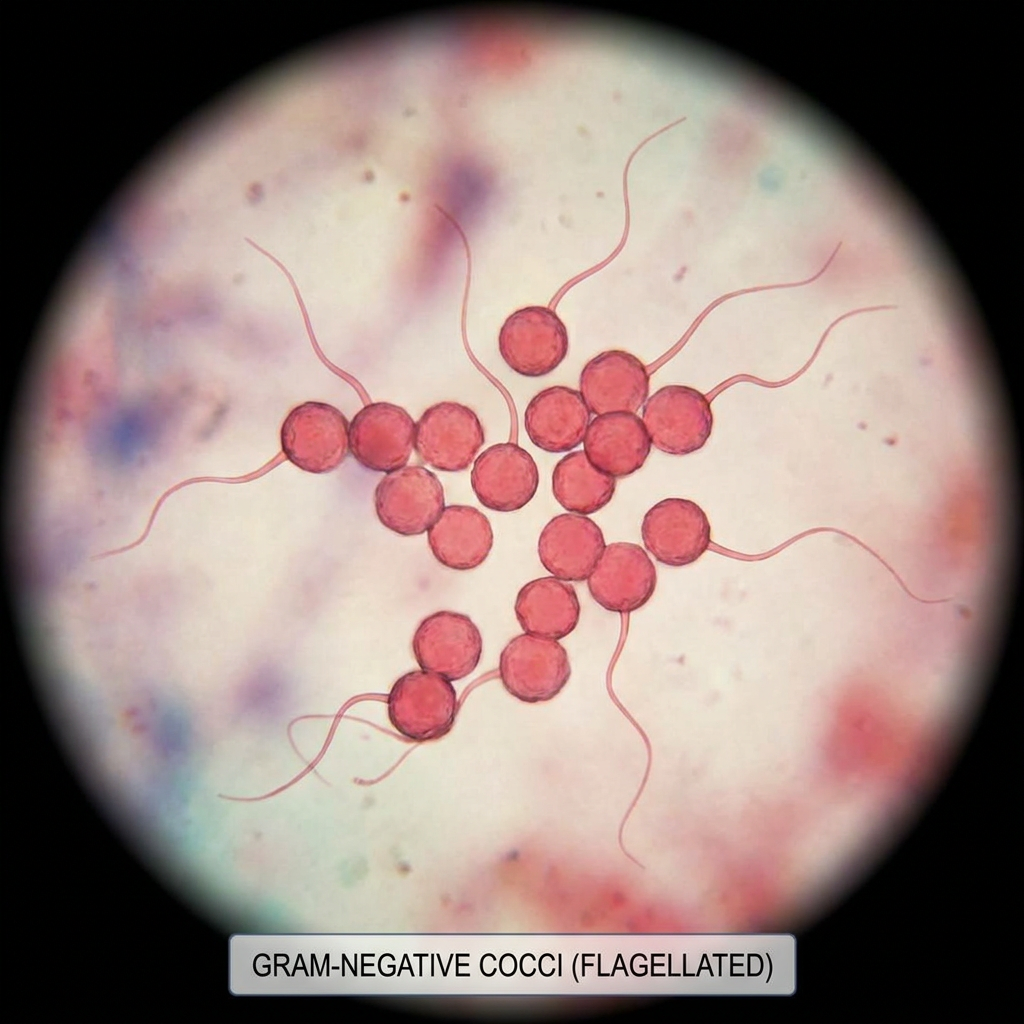
| Gram staining properties | Negative |
| Shape | Cocci |
| Mobility | No |
| Flagellar presence | Yes |
| Number of membranes | 2 |
| Ecology, Host, and Life Cycle | |
|---|---|
| Oxygen requirements | Facultative aerobe |
| Optimal temperature | 37 |
| Temperature range | Mesophilic |
| Habitat | HostAssociated |
| Biotic relationship | Free living |
| Host(s) | Not Available |
| Cell arrangement | Chains - Pairs - Singles |
| Sporulation | Not Available |
| Energy source | Not Available |
| Pathogenicity | Not Available |
Genome Summary
Brucella melitensis
Accession NumberNZ_CP035797.1
Gene Summary
Adenine Count
Not Available
Thymine Count
Not Available
Guanine Count
Not Available
Cytosine Count
Not Available
Genome Length
Not Available
Protein-coding Genes
2053 genes
Non-Coding Genes
65 genes
# of Chromosomes/Plasmids
2
Genes
| Name | Locus Tag | UniProt | Strand | Coordinates | Molecular Weight |
|---|---|---|---|---|---|
| Terminase large subunit | EXD79_RS10430 | Not Available | + | 2006760 - 2008019 | 45873.8 |
| Portal protein | EXD79_RS10435 | Not Available | + | 2008051 - 2009244 | 43659.9 |
| duf6107 family protein | EXD79_RS10440 | Not Available | + | 2009241 - 2009618 | 13025.0 |
| Putative prohead protease | EXD79_RS10445 | Not Available | + | 2009605 - 2010274 | 23586.6 |
| Phage major capsid protein | EXD79_RS10450 | Not Available | + | 2010296 - 2011570 | 46066.6 |
| Dna packaging/head-tail-connector | EXD79_RS10455 | Not Available | + | 2011735 - 2012301 | 21020.3 |
| Head-tail connector complex protein | EXD79_RS10460 | Not Available | + | 2012298 - 2012636 | 12693.2 |
| Duf3168 domain-containing protein | EXD79_RS10465 | Not Available | + | 2012758 - 2013165 | 15048.1 |
| Gene transfer aget (gta) orfg9-like phage major tail protein | EXD79_RS10470 | Not Available | + | 2013206 - 2013619 | 14784.4 |
| gene transfer agent family protein | EXD79_RS10475 | Not Available | + | 2013616 - 2013957 | 12009.3 |
Pathways
22 pathways
1,6-Anhydro-N-acetylmuramic Acid Recycling
1,6-Anhydro-N-acetylmuramic Acid Recycling

