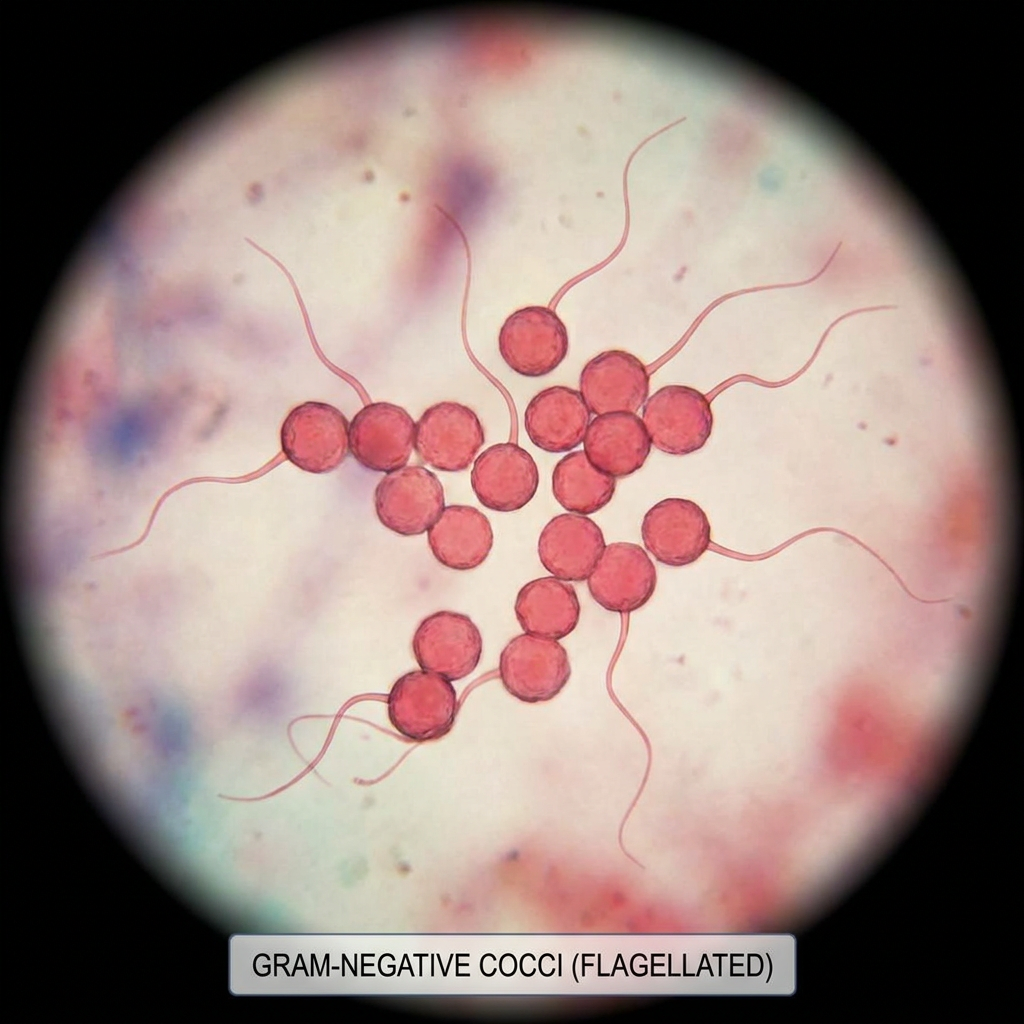
Brucella melitensis

Gram-negativeCocciNon-motileFacultative aerobe

Kingdom

Pseudomonadati

Phylum

Pseudomonadota

Class

Alphaproteobacteria

Order

Hyphomicrobiales

Family

Brucellaceae

Genus

Brucella

Description

Brucella melitensis, a gram-negative, rod-shaped microbe, thrives in temperatures ranging from 25°C to 39°C, categorizing it as a mesophile. As a facultative chemoheterotroph, it derives energy from the breakdown of organic compounds, utilizing carbon sources such as glucose and glycogen. This microbe's metabolism is fueled by aerobic respiration, utilizing oxygen as its primary energy source. In the presence of sufficient oxygen, it produces ATP through the process of cellular respiration, releasing carbon dioxide and water as byproducts. Brucella melitensis is ubiquitous, colonizing various body sites across all possible species, including humans, animals, and milk, where it infects mammary glands, causing brucellosis. It can also be found in soil and water, potentially transmitting infection through contact with contaminated environments. As an obligate aerobe, Brucella melitensis requires oxygen to survive and flourish. It cannot tolerate anaerobic conditions, as it lacks the necessary mechanisms to function in the absence of oxygen. A common zoonotic pathogen, Brucella melitensis is responsible for significant morbidity and mortality worldwide. It is typically transmitted through contact with infected animals, contaminated milk, or contaminated soil and water. In humans, it can cause a range of symptoms, from mild to severe, including fever, headache, and joint pain. In addition to its significant impact on human health, Brucella melitensis has also been recognized as a model organism for studying intracellular parasitism, providing valuable insights into the mechanisms of microbial pathogenesis and host-pathogen interactions.

Taxonomy

KingdomPseudomonadati
PhylumPseudomonadota
ClassAlphaproteobacteria
OrderHyphomicrobiales
FamilyBrucellaceae
GenusBrucella
SpeciesBrucella melitensis
StrainNo strain

Profile

Physiology
Gram staining propertiesNegative
ShapeCocci
MobilityNo
Flagellar presenceYes
Number of membranes2
Image of Brucella melitensis
Ecology, Host, and Life Cycle
Oxygen requirementsFacultative aerobe
Optimal temperature37
Temperature rangeMesophilic
HabitatHostAssociated
Biotic relationshipFree living
Host(s)Not Available
Cell arrangementChains - Pairs - Singles
SporulationNot Available
Energy sourceNot Available
PathogenicityNot Available

Genome Summary

Brucella melitensis

Accession NumberNZ_CP035797.1

Gene Summary

Adenine Count

Not Available

Thymine Count

Not Available

Guanine Count

Not Available

Cytosine Count

Not Available

Genome Length

Not Available

Protein-coding Genes

2053 genes

Non-Coding Genes

65 genes

# of Chromosomes/Plasmids

2

Genes

NameLocus TagUniProtStrandCoordinatesMolecular Weight
Terminase large subunitEXD79_RS10430Not Available+2006760 - 200801945873.8
Portal proteinEXD79_RS10435Not Available+2008051 - 200924443659.9
duf6107 family proteinEXD79_RS10440Not Available+2009241 - 200961813025.0
Putative prohead proteaseEXD79_RS10445Not Available+2009605 - 201027423586.6
Phage major capsid proteinEXD79_RS10450Not Available+2010296 - 201157046066.6
Dna packaging/head-tail-connectorEXD79_RS10455Not Available+2011735 - 201230121020.3
Head-tail connector complex proteinEXD79_RS10460Not Available+2012298 - 201263612693.2
Duf3168 domain-containing proteinEXD79_RS10465Not Available+2012758 - 201316515048.1
Gene transfer aget (gta) orfg9-like phage major tail proteinEXD79_RS10470Not Available+2013206 - 201361914784.4
gene transfer agent family proteinEXD79_RS10475Not Available+2013616 - 201395712009.3

Displaying genes 1 – 10 of 3246 in total

Pathways

22 pathways

Metabolites

86 records
Metabolite IDMetabolite nameStructureCAS number
BASm0017691PS(14:0/18:1(11Z))C38H72NO10PChemical structure of PS(14:0/18:1(11Z))NULL
Average733.965Da
Monoisotopic733.48938452Da
BASm0017737PG(14:1(7Z)/14:1(7Z))C34H63O10PChemical structure of PG(14:1(7Z)/14:1(7Z))NULL
Average662.842Da
Monoisotopic662.415885227Da
BASm0017743Stearoyl-CoAC39H70N7O17P3SChemical structure of Stearoyl-CoA362-66-3
Average1033.996Da
Monoisotopic1033.376174075Da
BASm0017775PE(12:0/14:0)C31H62NO8PChemical structure of PE(12:0/14:0)NULL
Average607.81Da
Monoisotopic607.421304958Da
BASm0017777PE(12:0/16:0)C33H66NO8PChemical structure of PE(12:0/16:0)NULL
Average635.864Da
Monoisotopic635.452605087Da
BASm0017778PE(12:0/16:1(9Z))C33H64NO8PChemical structure of PE(12:0/16:1(9Z))NULL
Average633.848Da
Monoisotopic633.436955023Da
BASm0017781PE(12:0/18:1(11Z))C35H68NO8PChemical structure of PE(12:0/18:1(11Z))NULL
Average661.902Da
Monoisotopic661.468255152Da
BASm0018523CDP-DG(12:0/14:0)C38H69N3O15P2Chemical structure of CDP-DG(12:0/14:0)NULL
Average869.924Da
Monoisotopic869.42039253Da
BASm0018525CDP-DG(12:0/16:0)C40H73N3O15P2Chemical structure of CDP-DG(12:0/16:0)NULL
Average897.978Da
Monoisotopic897.451692659Da
BASm0018526CDP-DG(12:0/16:1(9Z))C40H71N3O15P2Chemical structure of CDP-DG(12:0/16:1(9Z))NULL
Average895.962Da
Monoisotopic895.436042594Da

Displaying 21–30 of 86 metabolites