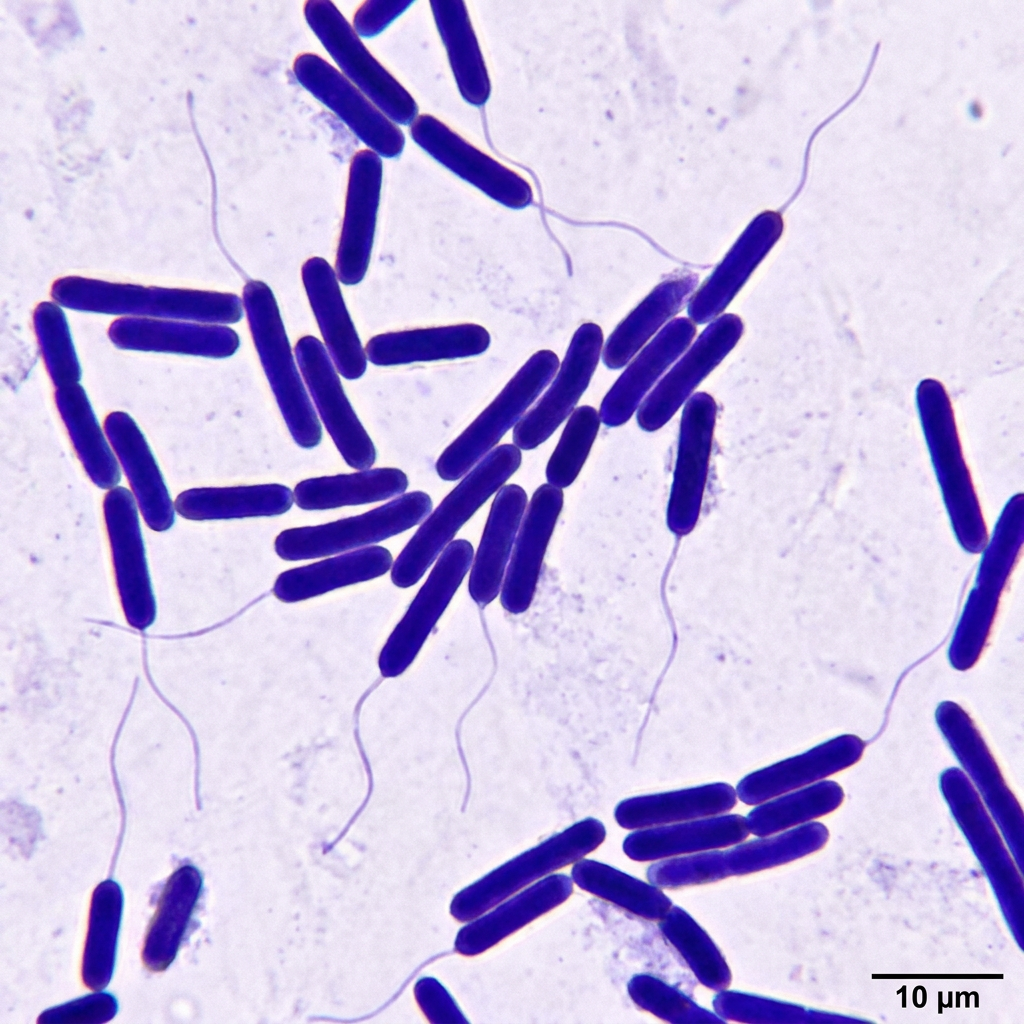
Kingdom
Bacillati
Phylum
Bacillota
Class
Bacilli
Order
Caryophanales
Family
Listeriaceae
Genus
Listeria
Description
Taxonomy
| Kingdom | Bacillati |
|---|---|
| Phylum | Bacillota |
| Class | Bacilli |
| Order | Caryophanales |
| Family | Listeriaceae |
| Genus | Listeria |
| Species | Listeria grayi |
| Strain | No strain |
Profile
| Physiology | |
|---|---|
| Gram staining properties | Positive |
| Shape | Not Available |
| Mobility | Yes |
| Flagellar presence | Not Available |
| Number of membranes | Not Available |
| Ecology, Host, and Life Cycle | |
|---|---|
| Oxygen requirements | Facultative anaerobe |
| Optimal temperature | Not Available |
| Temperature range | Not Available |
| Habitat | Not Available |
| Biotic relationship | Not Available |
| Host(s) | Not Available |
| Cell arrangement | Not Available |
| Sporulation | Not Available |
| Energy source | Not Available |
| Pathogenicity | Human; Non-pathogenic |
Genome Summary
Listeria grayi
Accession NumberUGPG00000000.1
Gene Summary
Adenine Count
Not Available
Thymine Count
Not Available
Guanine Count
Not Available
Cytosine Count
Not Available
Genome Length
Not Available
Protein-coding Genes
Not Available
Non-Coding Genes
Not Available
# of Chromosomes/Plasmids
2
Genes
| Name | Locus Tag | UniProt | Strand | Coordinates | Molecular Weight |
|---|---|---|---|---|---|
| gnat family n-acetyltransferase | EL241_RS02180 | Not Available | - | 460413 - 460901 | 18266.1 |
| mate family efflux transporter | EL241_RS02185 | Not Available | - | 460924 - 462270 | 50123.8 |
| merr family dna-binding transcriptional regulator | EL241_RS02190 | Not Available | + | 462345 - 463109 | 29813.9 |
| hypothetical protein | EL241_RS02195 | Not Available | - | 463143 - 463520 | 13873.0 |
| aaa family atpase | EL241_RS02200 | Not Available | + | 463781 - 464272 | 18027.0 |
| tetr/acrr family transcriptional regulator | EL241_RS02205 | Not Available | + | 464348 - 464899 | 20658.2 |
| mfs transporter | EL241_RS02210 | Not Available | + | 464964 - 466097 | 40200.1 |
| yybh family protein | EL241_RS02215 | Not Available | - | 466139 - 466567 | 16084.0 |
| 1-phosphofructokinase family hexose kinase | EL241_RS02220 | Not Available | - | 466660 - 467604 | 33988.9 |
| deor/glpr family dna-binding transcription regulator | EL241_RS02225 | Not Available | - | 467605 - 468363 | 29125.1 |
Pathways
0 pathways
No pathways found
No metabolic pathways have been associated with this bacterium yet.