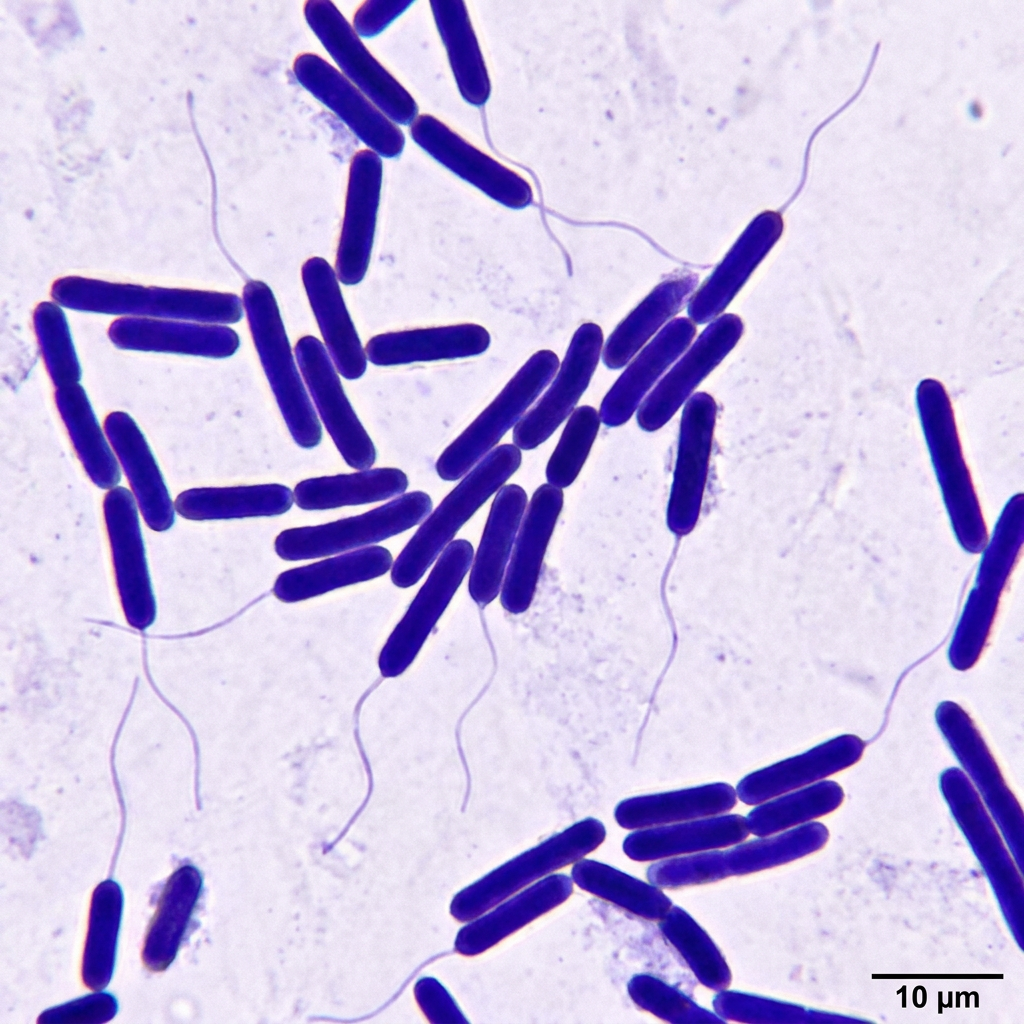
Clostridium butyricum

Gram-positiveAnaerobe

Kingdom

Bacillati

Phylum

Bacillota

Class

Clostridia

Order

Eubacteriales

Family

Clostridiaceae

Genus

Clostridium

Description

Clostridium butyricum is a Gram-positive, rod-shaped microbe that thrives in a mesophilic temperature range, preferring temperatures between 25-40°C. It is classified as a chemoheterotroph, utilizing organic compounds as its energy source. C. butyricum produces energy through anaerobic fermentation, specifically by converting glucose into butyric acid, acetate, and hydrogen gas. This process is essential for its survival, as it allows the microbe to survive in environments where oxygen is scarce or absent. The Gram-staining property of C. butyricum indicates that its cell wall contains a thick peptidoglycan layer, which is characteristic of Gram-positive bacteria. Its rod-shaped morphology allows it to move efficiently through its surroundings, facilitating the absorption of nutrients and the release of waste products. C. butyricum is an obligate anaerobe, meaning it cannot survive in the presence of oxygen and will die if exposed to it. This adaptation is crucial for its survival in environments where oxygen levels are low, such as the human gut. Its anaerobic metabolism also enables it to produce short-chain fatty acids, which can serve as energy sources for other microorganisms. This microbe can be found in various body sites, including the human gut, where it plays a role in the decomposition of complex nutrients and the production of volatile fatty acids. C. butyricum has also been isolated from soil, freshwater, and marine environments, highlighting its remarkable adaptability. In addition to its role in decomposition and nutrient cycling, C. butyricum has been explored for its potential applications in medicine and biotechnology. For instance, its ability to produce butyric acid has been exploited in the development of probiotics, which can help maintain a healthy gut microbiome. Furthermore, its enzymes have been used in the production of biofuels and bioplastics, demonstrating its significance in the search for sustainable energy solutions.

Taxonomy

KingdomBacillati
PhylumBacillota
ClassClostridia
OrderEubacteriales
FamilyClostridiaceae
GenusClostridium
SpeciesClostridium butyricum
StrainNo strain

Profile

Physiology
Gram staining propertiesPositive
ShapeNot Available
MobilityNot Available
Flagellar presenceNot Available
Number of membranesNot Available
Ecology, Host, and Life Cycle
Oxygen requirementsAnaerobe
Optimal temperatureNot Available
Temperature rangemesophilic
Habitatrumen
Biotic relationshipNot Available
Host(s)Not Available
Cell arrangementNot Available
SporulationNot Available
Energy sourceNot Available
PathogenicityNot Available

Genome Summary

Clostridium butyricum

Accession NumberRSEV00000000.1

Gene Summary

Adenine Count

Not Available

Thymine Count

Not Available

Guanine Count

Not Available

Cytosine Count

Not Available

Genome Length

Not Available

Protein-coding Genes

3843 genes

Non-Coding Genes

218 genes

# of Chromosomes/Plasmids

1

Genes

NameLocus TagUniProtStrandCoordinatesMolecular Weight
AttlNot AvailableNot Available+2981641 - 2981652Not Available
AttlNot AvailableNot Available+2983845 - 2983857Not Available
Putative lysinEI970_13875Not Available-2986463 - 298741035708.0
HolinEI970_13880Not Available-2987465 - 29877138933.46
Hypothetical secreted or membrane proteinEI970_13885Not Available-2987715 - 298799910798.8
Xerd-like integraseEI970_13890Not Available-2988062 - 298906639090.3
AcyltransferaseEI970_13895Not Available-2989322 - 299035940249.0
Hypothetical proteinEI970_13900Not Available-2990460 - 299282389700.8
Hypothetical proteinEI970_13905Not Available-2992837 - 29930498181.4
hypothetical proteinEI970_13910Not Available-2993042 - 299335912062.3

Displaying genes 1 – 10 of 4061 in total

Pathways

67 pathways

Metabolites

131 records
Metabolite IDMetabolite nameStructureCAS number
BASm0017405CDP-DG(18:1(9Z)/16:0)C46H83N3O15P2Chemical structure of CDP-DG(18:1(9Z)/16:0)NULL
Average980.124Da
Monoisotopic979.529942981Da
BASm0017406CDP-DG(18:1(9Z)/18:0)C48H87N3O15P2Chemical structure of CDP-DG(18:1(9Z)/18:0)NULL
Average1008.178Da
Monoisotopic1007.561243109Da
BASm0017409PA(16:0/18:1(9Z))C37H71O8PChemical structure of PA(16:0/18:1(9Z))NULL
Average674.941Da
Monoisotopic674.488656244Da
BASm0017415PA(18:1(9Z)/18:1(9Z))C39H73O8PChemical structure of PA(18:1(9Z)/18:1(9Z))14268-17-8
Average700.979Da
Monoisotopic700.504306309Da
BASm0017416PE(14:0/14:0)C33H66NO8PChemical structure of PE(14:0/14:0)NULL
Average635.864Da
Monoisotopic635.452605087Da
BASm0017417PE(14:0/16:0)C35H70NO8PChemical structure of PE(14:0/16:0)NULL
Average663.918Da
Monoisotopic663.483905216Da
BASm0017418PE(14:0/16:1(9Z))C35H68NO8PChemical structure of PE(14:0/16:1(9Z))NULL
Average661.902Da
Monoisotopic661.468255152Da
BASm0017420PE(16:0/14:0)C35H70NO8PChemical structure of PE(16:0/14:0)NULL
Average663.918Da
Monoisotopic663.483905216Da
BASm0017422PE(16:1(9Z)/14:0)C35H68NO8PChemical structure of PE(16:1(9Z)/14:0)NULL
Average661.902Da
Monoisotopic661.468255152Da
BASm0017423PE(16:1(9Z)/16:0)C37H72NO8PChemical structure of PE(16:1(9Z)/16:0)NULL
Average689.956Da
Monoisotopic689.49955528Da

Displaying 11–20 of 131 metabolites