Kingdom
Bacillati
Phylum
Bacillota
Class
Tissierellia
Order
Tissierellales
Family
Peptoniphilaceae
Genus
Finegoldia
Description
Taxonomy
| Kingdom | Bacillati |
|---|---|
| Phylum | Bacillota |
| Class | Tissierellia |
| Order | Tissierellales |
| Family | Peptoniphilaceae |
| Genus | Finegoldia |
| Species | Finegoldia magna |
| Strain | No strain |
Profile
| Physiology | |
|---|---|
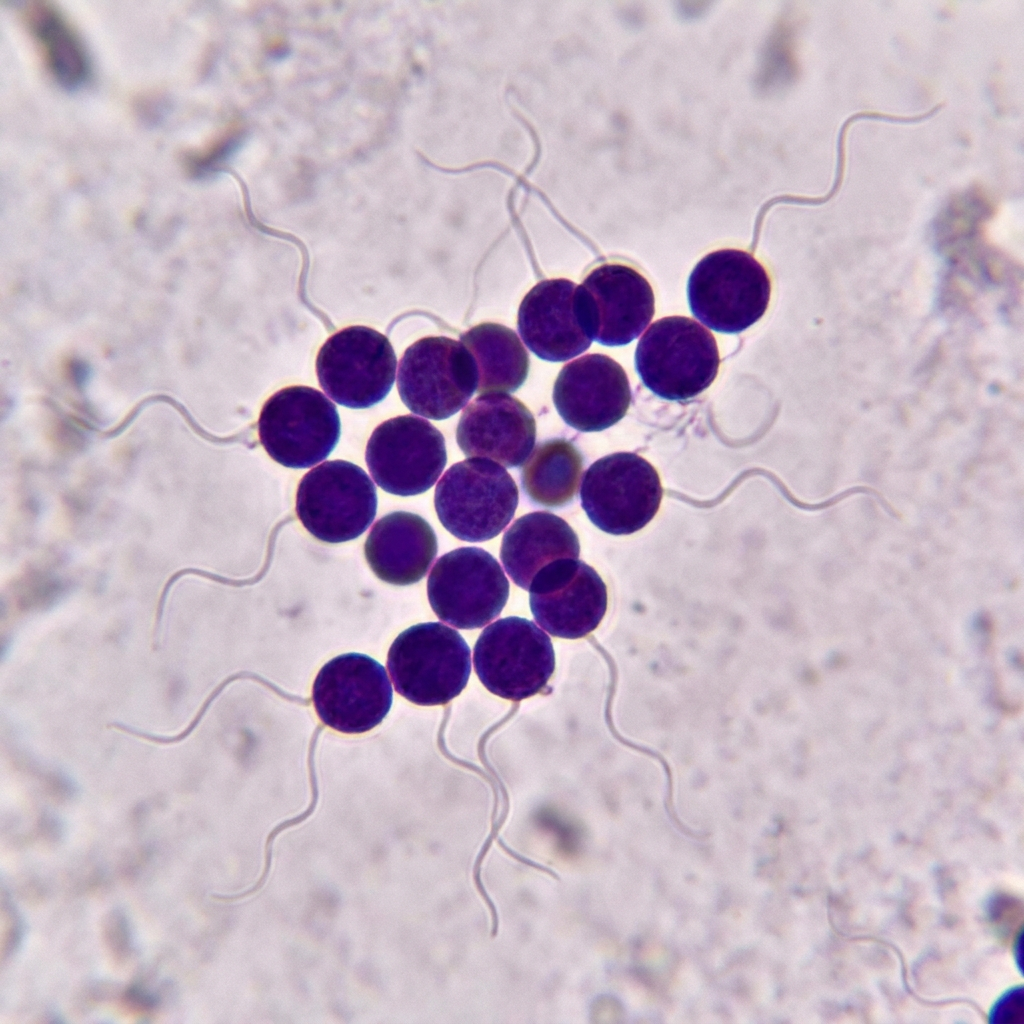
| Gram staining properties | Positive |
| Shape | Cocci |
| Mobility | No |
| Flagellar presence | Yes |
| Number of membranes | 1 |
| Ecology, Host, and Life Cycle | |
|---|---|
| Oxygen requirements | Anaerobe |
| Optimal temperature | Not Available |
| Temperature range | Mesophilic |
| Habitat | Multiple |
| Biotic relationship | Free living |
| Host(s) | Not Available |
| Cell arrangement | Not Available |
| Sporulation | Not Available |
| Energy source | Not Available |
| Pathogenicity | Not Available |
Genome Summary
Finegoldia magna
Accession NumberNDYI00000000.1
Gene Summary
Adenine Count
Not Available
Thymine Count
Not Available
Guanine Count
Not Available
Cytosine Count
Not Available
Genome Length
Not Available
Protein-coding Genes
1765 genes
Non-Coding Genes
46 genes
# of Chromosomes/Plasmids
3
Genes
| Name | Locus Tag | UniProt | Strand | Coordinates | Molecular Weight |
|---|---|---|---|---|---|
| hypothetical protein | HMPREF3217_00115 | Not Available | - | 103584 - 103718 | 5374.47 |
| phage xkdn-like protein | HMPREF3217_00116 | Not Available | - | 103739 - 104119 | 14542.3 |
| Tail tube protein | HMPREF3217_00117 | Not Available | - | 104130 - 104561 | 15769.8 |
| Tail sheath subtilisin-like domain-containing protein | HMPREF3217_00118 | Q24LI4 | - | 104573 - 105664 | 41302.2 |
| 16s ribosomal rna | Not Available | Not Available | + | 63 - 1572 | Not Available |
| aminopeptidase i zinc metalloprotease | HMPREF3217_00001 | Q97K30 | - | 76 - 1485 | 52268.4 |
| 5s ribosomal rna | Not Available | Not Available | + | 1825 - 1939 | Not Available |
| glutamate racemase | HMPREF3217_00002 | Q8RAJ0 | - | 1466 - 2251 | 29466.5 |
| 4-(cytidine 5'-diphospho)-2-c-methyl-d-erythritol kinase | HMPREF3217_00003 | B0S057 | - | 2226 - 3059 | 31508.4 |
| glutaredoxin | HMPREF3217_00004 | Not Available | - | 3049 - 3315 | 10392.5 |
Pathways
0 pathways
No pathways found
No metabolic pathways have been associated with this bacterium yet.