Kingdom
Bacillati
Phylum
Bacillota
Class
Tissierellia
Order
Tissierellales
Family
Peptoniphilaceae
Genus
Finegoldia
Description
Taxonomy
| Kingdom | Bacillati |
|---|---|
| Phylum | Bacillota |
| Class | Tissierellia |
| Order | Tissierellales |
| Family | Peptoniphilaceae |
| Genus | Finegoldia |
| Species | Finegoldia magna |
| Strain | No strain |
Profile
| Physiology | |
|---|---|
| Gram staining properties | Positive |
| Shape | Cocci |
| Mobility | No |
| Flagellar presence | Yes |
| Number of membranes | 1 |
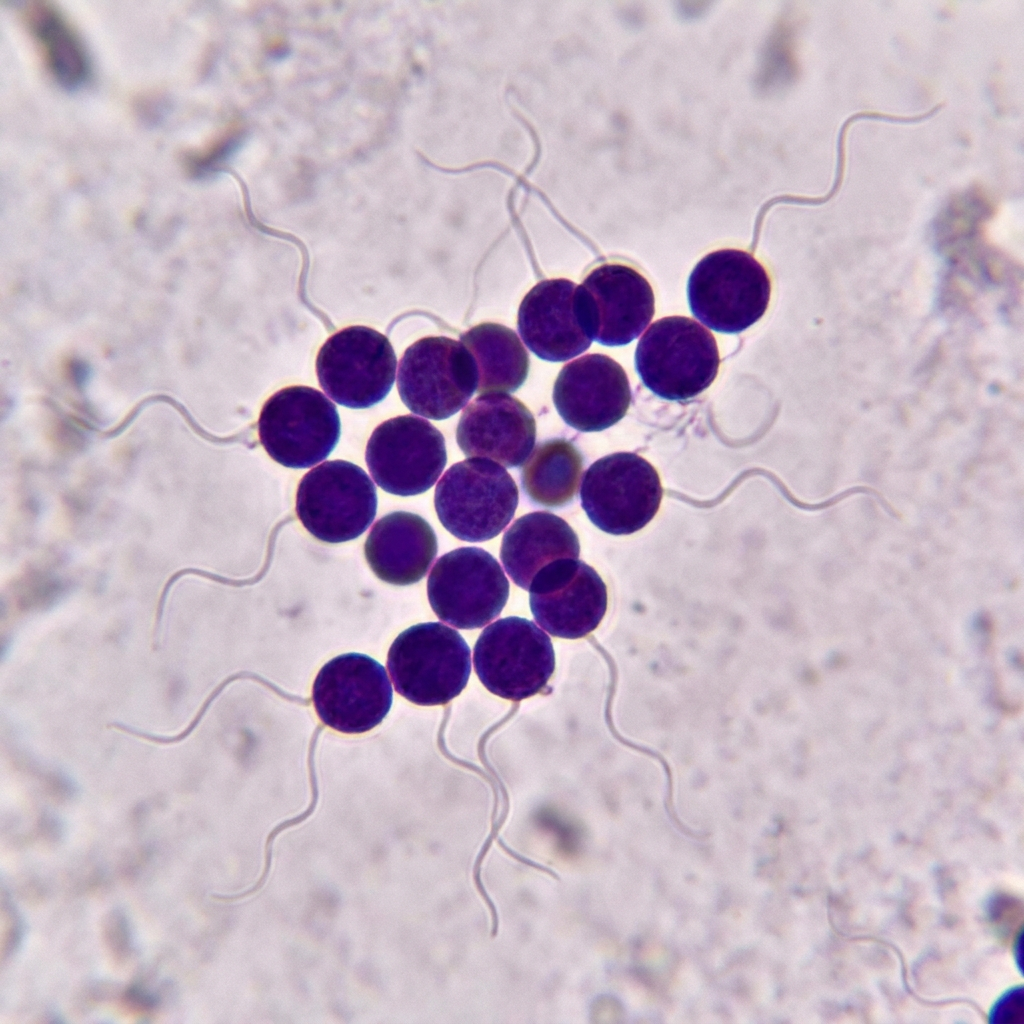
| Ecology, Host, and Life Cycle | |
|---|---|
| Oxygen requirements | Anaerobe |
| Optimal temperature | Not Available |
| Temperature range | Mesophilic |
| Habitat | Multiple |
| Biotic relationship | Free living |
| Host(s) | Not Available |
| Cell arrangement | Not Available |
| Sporulation | Not Available |
| Energy source | Not Available |
| Pathogenicity | Not Available |
Genome Summary
Finegoldia magna
Accession NumberNDYI00000000.1
Gene Summary
Adenine Count
Not Available
Thymine Count
Not Available
Guanine Count
Not Available
Cytosine Count
Not Available
Genome Length
Not Available
Protein-coding Genes
1765 genes
Non-Coding Genes
46 genes
# of Chromosomes/Plasmids
3
Genes
| Name | Locus Tag | UniProt | Strand | Coordinates | Molecular Weight |
|---|---|---|---|---|---|
| histidinol phosphate phosphatase hisj family protein | HMPREF3217_00268 | Not Available | - | 263489 - 264280 | 31523.4 |
| deoxyribose-phosphate aldolase | HMPREF3217_00269 | B0S0N1 | - | 264329 - 264979 | 23307.2 |
| purine nucleoside phosphorylase | HMPREF3217_00270 | A0Q1A0 | - | 264972 - 265676 | 26080.0 |
| hypothetical protein | HMPREF3217_00271 | Not Available | - | 265686 - 265949 | 10196.5 |
| ribosomal subunit interface protein | HMPREF3217_00272 | A0A0H3GEZ8 | - | 266019 - 266558 | 20826.1 |
| hypothetical protein | HMPREF3217_00273 | O32222 | - | 266709 - 266972 | 10009.3 |
| heavy metal-associated domain protein | HMPREF3217_00274 | Not Available | - | 266972 - 267172 | 7275.73 |
| copper-exporting atpase | HMPREF3217_00275 | Q6G6B7 | - | 267172 - 269514 | 85632.3 |
| nicotinate phosphoribosyltransferase | HMPREF3217_00276 | O32090 | + | 269630 - 271078 | 55231.3 |
| adenine phosphoribosyltransferase | HMPREF3217_00277 | B0S0M3 | - | 271159 - 271683 | 19216.2 |
Pathways
0 pathways
No pathways found
No metabolic pathways have been associated with this bacterium yet.