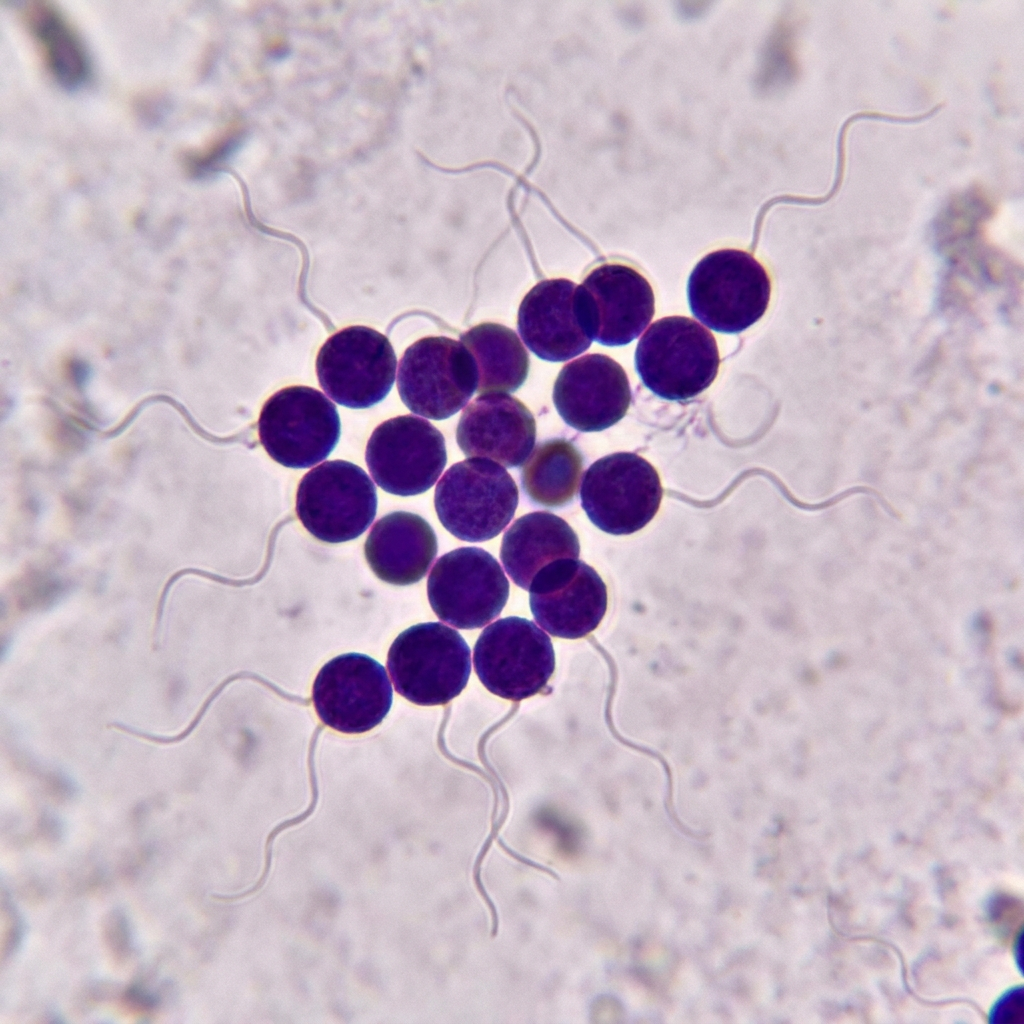
Pediococcus pentosaceus

Gram-positiveCocciNon-motileFacultative anaerobe

Kingdom

Bacillati

Phylum

Bacillota

Class

Bacilli

Order

Lactobacillales

Family

Lactobacillaceae

Genus

Pediococcus

Description

Pediococcus pentosaceus is a gram-positive, spherical bacterium (cocci) that typically forms pairs or tetrads, thriving at mesophilic temperatures (optimal around 30-37°C). This organism is a chemoheterotroph, obtaining its energy and carbon from organic compounds, and is classified as a facultative anaerobe, able to grow in both aerobic and anaerobic conditions. As a gram-positive bacterium, Pediococcus pentosaceus retains the crystal violet stain used in the Gram staining procedure, resulting in a characteristic purple hue. Its coccoid shape and tendency to form clusters contribute to its distinctive morphology, which can be observed under the microscope. The mesophilic nature of this microbe makes it particularly suited for fermentation processes that occur at moderate temperatures, such as those in the food industry. As a chemoheterotroph, Pediococcus pentosaceus primarily relies on various carbohydrates for energy, demonstrating its versatility in utilizing different organic substrates. Its facultative anaerobic capability allows it to grow in the presence or absence of oxygen, making it a highly adaptable organism in different environments, especially in fermented food systems. This bacterium is predominantly found in plant materials, fermented foods, and the gastrointestinal tracts of animals, indicating its role in both natural ecosystems and human food production. It is commonly used as a starter culture in the fermentation of vegetables, meats, and dairy products, contributing to the production of foods like pickles and sausages. Beyond its culinary applications, Pediococcus pentosaceus is noted for its ability to produce bacteriocins, which are antimicrobial peptides that can inhibit the growth of pathogenic bacteria, thus enhancing food safety and preservation. This property not only adds value to the fermentation process but also supports the concept of using natural preservatives in food products.

Taxonomy

KingdomBacillati
PhylumBacillota
ClassBacilli
OrderLactobacillales
FamilyLactobacillaceae
GenusPediococcus
SpeciesPediococcus pentosaceus
StrainNo strain

Profile

Physiology
Gram staining propertiesPositive
ShapeCocci
MobilityNo
Flagellar presenceYes
Number of membranes1
Image of Pediococcus pentosaceus
Ecology, Host, and Life Cycle
Oxygen requirementsFacultative anaerobe
Optimal temperature30
Temperature rangeMesophilic
HabitatMultiple
Biotic relationshipFree living
Host(s)Not Available
Cell arrangementTetrads
SporulationNot Available
Energy sourceNot Available
PathogenicityNot Available

Genome Summary

Pediococcus pentosaceus

Accession NumberJQBF00000000.1

Gene Summary

Adenine Count

551519 bp

Thymine Count

540013 bp

Guanine Count

334565 bp

Cytosine Count

313408 bp

Genome Length

1739506 bp

Protein-coding Genes

1648 genes

Non-Coding Genes

55 genes

# of Chromosomes/Plasmids

2

Genes

NameLocus TagUniProtStrandCoordinatesMolecular Weight
hemolysin iii-like proteinIV86_GL000001P54176-74 - 71223496.8
bs ykrk family proteinIV86_GL000002Not Available+840 - 129818130.2
c-di-gmp-specific phosphodiesteraseIV86_GL000003Not Available-1334 - 201425986.9
nad(fad)-dependent dehydrogenaseIV86_GL000004Not Available+2139 - 350049930.5
hypothetical proteinIV86_GL000005Not Available-3585 - 422324802.7
membrane transporterIV86_GL000006Q8XDQ5-4243 - 456311568.8
hypothetical proteinIV86_GL000007Not Available-4825 - 529217127.6
hypothetical proteinIV86_GL000008Not Available-5316 - 665347901.6
permease, cadmium resistance proteinIV86_GL000009Not Available-6781 - 738621837.9
arsr family transcriptional regulatorIV86_GL000010Not Available+7452 - 778712947.9

Displaying genes 1 – 10 of 3714 in total

Pathways

0 pathways

No pathways found

No metabolic pathways have been associated with this bacterium yet.

Metabolites

91 records
Metabolite IDMetabolite nameStructureCAS number
BASm0002826(2R)-3-phospho-glyceroyl phosphateC3H4O10P2Chemical structure of (2R)-3-phospho-glyceroyl phosphateNot available
Average262.005Da
Monoisotopic261.9301646Da
BASm0002963meso-2,6-diaminoheptanedioateC7H14N2O4Chemical structure of meso-2,6-diaminoheptanedioate922-54-3
Average190.1971Da
Monoisotopic190.0953569Da
BASm00029834-CDP-2-C-methyl-D-erythritolC14H23N3O14P2Chemical structure of 4-CDP-2-C-methyl-D-erythritolNot available
Average519.294Da
Monoisotopic519.0666236Da
BASm00030584-CDP-2-C-methyl-D-erythritol 2-phosphateC14H22N3O17P3Chemical structure of 4-CDP-2-C-methyl-D-erythritol 2-phosphateNot available
Average597.257Da
Monoisotopic597.0184016Da
BASm0003187N-succinyl-(2S,6S)-2,6-diaminoheptanedioateC11H16N2O7Chemical structure of N-succinyl-(2S,6S)-2,6-diaminoheptanedioateNot available
Average288.257Da
Monoisotopic288.096848Da
BASm0003208L-2-acetamido-6-oxoheptanedioateC9H11NO6Chemical structure of L-2-acetamido-6-oxoheptanedioateNot available
Average229.189Da
Monoisotopic229.059734238Da
BASm0003276S-(5-deoxy-D-ribos-5-yl)-L-homocysteineC9H17NO6SChemical structure of S-(5-deoxy-D-ribos-5-yl)-L-homocysteine15912-98-8
Average267.299Da
Monoisotopic267.077658Da
BASm0003296L-ribulose 5-phosphateC5H9O8PChemical structure of L-ribulose 5-phosphateNot available
Average228.094Da
Monoisotopic228.0046014Da
BASm0003333(2R)-3-phosphoglycerateC3H4O7PChemical structure of (2R)-3-phosphoglycerateNot available
Average183.033Da
Monoisotopic182.9711102Da
BASm0003334aldehydo-D-ribose 5-phosphateC5H11O8PChemical structure of aldehydo-D-ribose 5-phosphateNot available
Average230.1098Da
Monoisotopic230.0191538Da

Displaying 31–40 of 91 metabolites