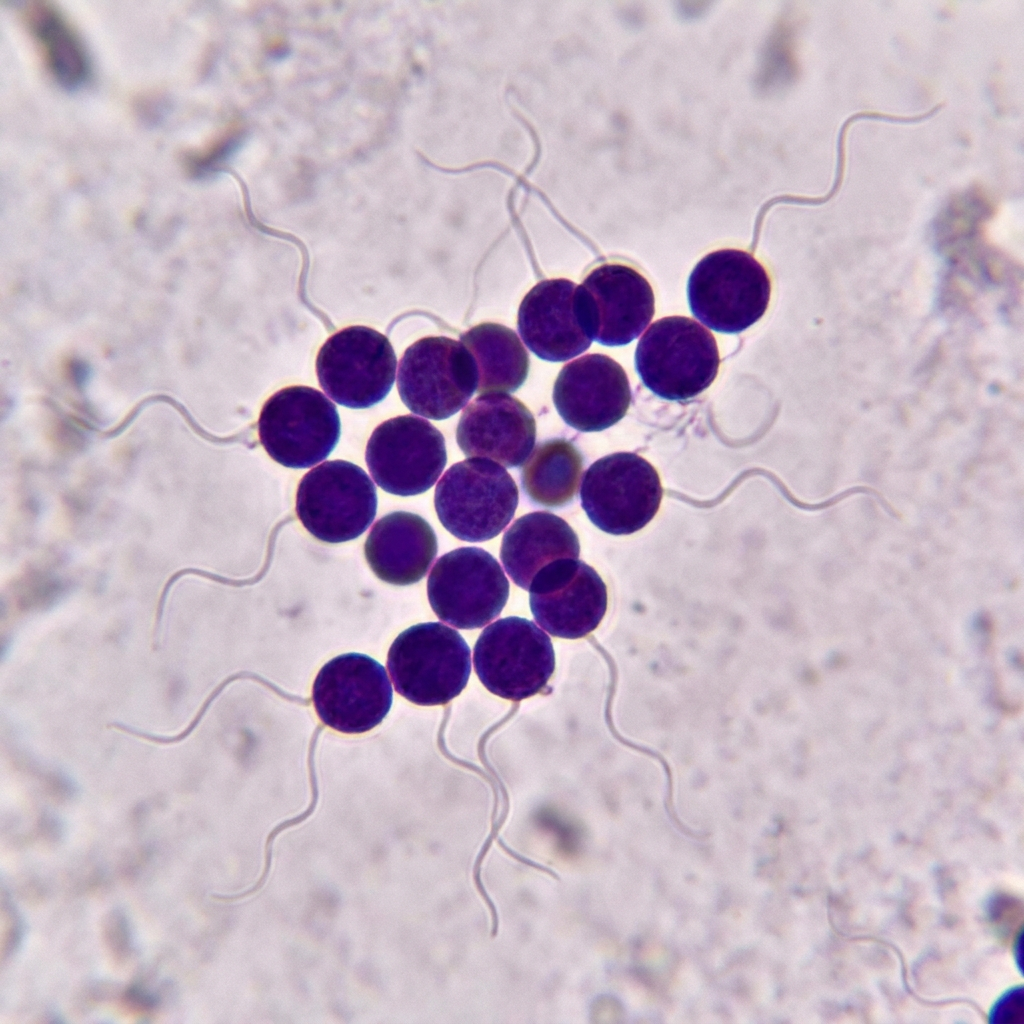
Pediococcus pentosaceus

Gram-positiveCocciNon-motileFacultative anaerobe

Kingdom

Bacillati

Phylum

Bacillota

Class

Bacilli

Order

Lactobacillales

Family

Lactobacillaceae

Genus

Pediococcus

Description

Pediococcus pentosaceus is a gram-positive, spherical bacterium (cocci) that typically forms pairs or tetrads, thriving at mesophilic temperatures (optimal around 30-37°C). This organism is a chemoheterotroph, obtaining its energy and carbon from organic compounds, and is classified as a facultative anaerobe, able to grow in both aerobic and anaerobic conditions. As a gram-positive bacterium, Pediococcus pentosaceus retains the crystal violet stain used in the Gram staining procedure, resulting in a characteristic purple hue. Its coccoid shape and tendency to form clusters contribute to its distinctive morphology, which can be observed under the microscope. The mesophilic nature of this microbe makes it particularly suited for fermentation processes that occur at moderate temperatures, such as those in the food industry. As a chemoheterotroph, Pediococcus pentosaceus primarily relies on various carbohydrates for energy, demonstrating its versatility in utilizing different organic substrates. Its facultative anaerobic capability allows it to grow in the presence or absence of oxygen, making it a highly adaptable organism in different environments, especially in fermented food systems. This bacterium is predominantly found in plant materials, fermented foods, and the gastrointestinal tracts of animals, indicating its role in both natural ecosystems and human food production. It is commonly used as a starter culture in the fermentation of vegetables, meats, and dairy products, contributing to the production of foods like pickles and sausages. Beyond its culinary applications, Pediococcus pentosaceus is noted for its ability to produce bacteriocins, which are antimicrobial peptides that can inhibit the growth of pathogenic bacteria, thus enhancing food safety and preservation. This property not only adds value to the fermentation process but also supports the concept of using natural preservatives in food products.

Taxonomy

KingdomBacillati
PhylumBacillota
ClassBacilli
OrderLactobacillales
FamilyLactobacillaceae
GenusPediococcus
SpeciesPediococcus pentosaceus
StrainNo strain

Profile

Physiology
Gram staining propertiesPositive
ShapeCocci
MobilityNo
Flagellar presenceYes
Number of membranes1
Image of Pediococcus pentosaceus
Ecology, Host, and Life Cycle
Oxygen requirementsFacultative anaerobe
Optimal temperature30
Temperature rangeMesophilic
HabitatMultiple
Biotic relationshipFree living
Host(s)Not Available
Cell arrangementTetrads
SporulationNot Available
Energy sourceNot Available
PathogenicityNot Available

Genome Summary

Pediococcus pentosaceus

Accession NumberJQBF00000000.1

Gene Summary

Adenine Count

551519 bp

Thymine Count

540013 bp

Guanine Count

334565 bp

Cytosine Count

313408 bp

Genome Length

1739506 bp

Protein-coding Genes

1648 genes

Non-Coding Genes

55 genes

# of Chromosomes/Plasmids

2

Genes

NameLocus TagUniProtStrandCoordinatesMolecular Weight
ssu ribosomal protein s6pIV86_GL000031Q890K2-26045 - 2632910686.7
dna gyrase subunit aIV86_GL000032P0DG02-26576 - 2910793740.1
dna gyrase subunit bIV86_GL000033Q839Z1-29156 - 3110271966.9
recombination protein fIV86_GL000034Q03I57-31107 - 3214739261.8
s4-like rna binding proteinIV86_GL000035P05650-32231 - 324588469.01
dna polymerase iii, beta subunitIV86_GL000036P05649-32679 - 3381841960.0
chromosomal replication initiation proteinIV86_GL000037Q03I60-33996 - 3533650934.4
hypothetical proteinIV86_GL000038Q03D56+35867 - 360015376.76
rnase p protein componentIV86_GL000039Q03D57+36115 - 3647414017.2
preprotein translocase subunit yidcIV86_GL000040Q03D58+36474 - 3731331669.6

Displaying genes 31 – 40 of 3714 in total

Pathways

0 pathways

No pathways found

No metabolic pathways have been associated with this bacterium yet.

Metabolites

91 records
Metabolite IDMetabolite nameStructureCAS number
BASm0000217alpha-ribazoleC14H18N2O4Chemical structure of alpha-ribazoleNot available
Average278.3037Da
Monoisotopic278.126657074Da
BASm0000237(R)-4'-phosphopantothenateC9H18NO8PChemical structure of (R)-4'-phosphopantothenateNot available
Average299.2149Da
Monoisotopic299.0770031Da
BASm00002502,5-didehydro-D-gluconateC6H7O7Chemical structure of 2,5-didehydro-D-gluconate53736-12-2
Average191.1156Da
Monoisotopic191.019177578Da
BASm0000272(E)-4-coumarateC9H7O3Chemical structure of (E)-4-coumarateNot available
Average163.1501Da
Monoisotopic163.0395191Da
BASm0000274aldehydo-D-galacturonateC6H9O7Chemical structure of aldehydo-D-galacturonateNot available
Average193.132Da
Monoisotopic193.0353762Da
BASm0000377(S)-malateC4H4O5Chemical structure of (S)-malateNot available
Average132.0716Da
Monoisotopic132.005873238Da
BASm0000387(6R)-5,10-methylene-5,6,7,8-tetrahydrofolateC20H21N7O6Chemical structure of (6R)-5,10-methylene-5,6,7,8-tetrahydrofolateNot available
Average455.432Da
Monoisotopic455.1564286Da
BASm0000400(R)-10-hydroxyoctadecanoateC18H35O3Chemical structure of (R)-10-hydroxyoctadecanoateNot available
Average299.476Da
Monoisotopic299.2591686Da
BASm0000403(S)-acetoinC4H8O2Chemical structure of (S)-acetoinNot available
Average88.1051Da
Monoisotopic88.0524295Da
BASm00008763-hydroxypyruvateC3H3O4Chemical structure of 3-hydroxypyruvateNot available
Average103.054Da
Monoisotopic103.003682157Da

Displaying 1–10 of 91 metabolites