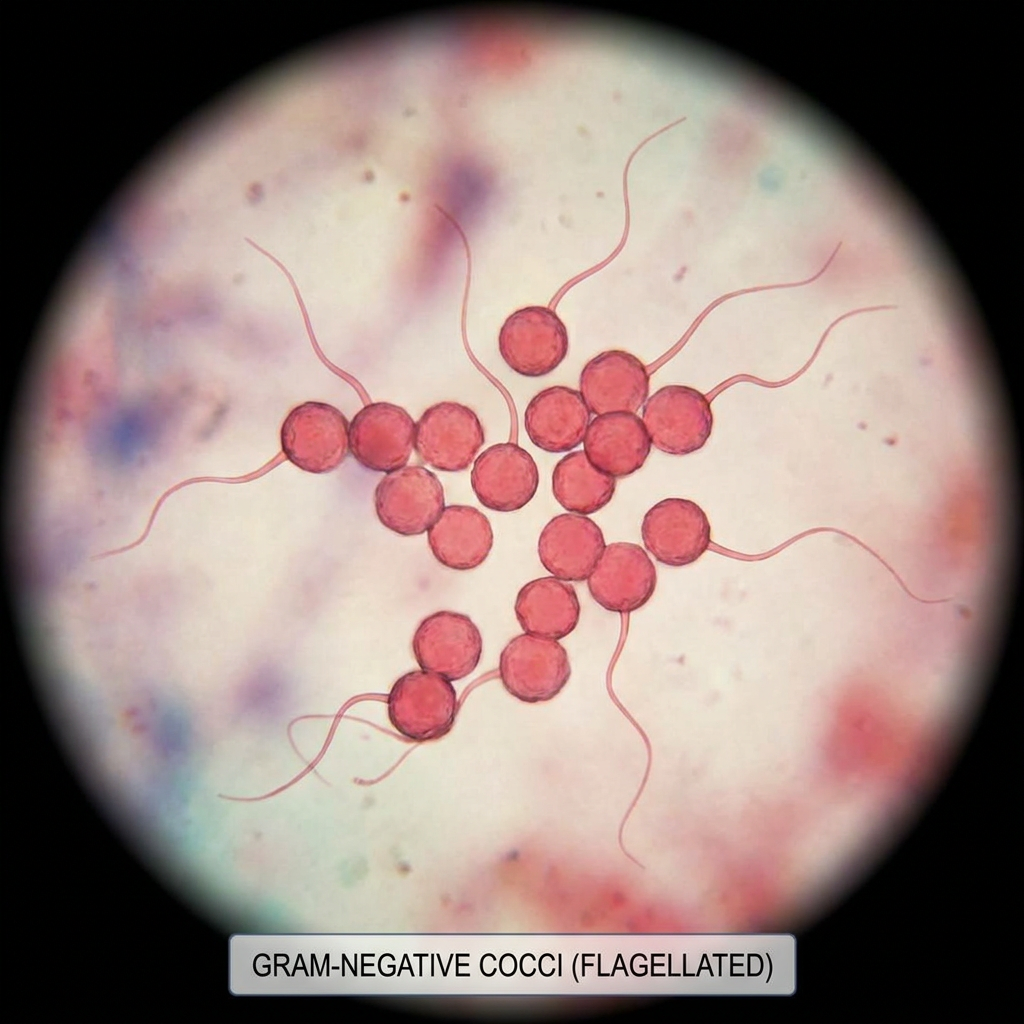
Chromobacterium violaceum

Gram-negativeCocciMotileFacultatively anaerobe

Kingdom

Pseudomonadati

Phylum

Pseudomonadota

Class

Betaproteobacteria

Order

Neisseriales

Family

Chromobacteriaceae

Genus

Chromobacterium

Description

Chromobacterium violaceum is a gram-negative, rod-shaped bacterium that thrives in temperatures ranging from 25°C to 37°C, categorizing it as a mesophile. It is a chemoheterotroph, meaning it obtains its energy by breaking down organic compounds, and utilizes sugars, amino acids, and other organic molecules as its carbon and energy source. C. violaceum uses aerobic respiration to produce energy, requiring the presence of oxygen to function optimally. The bacterium stains negative with the Gram stain, indicating the presence of a thin peptidoglycan layer in its cell wall. Its rod-shaped morphology allows it to be easily observed under a light microscope. C. violaceum is commonly found in a wide range of environments, including soil, water, and the human gastrointestinal tract, as well as other body sites such as the respiratory, urinary, and cutaneous tracts. The bacterium is an obligate aerobe, requiring the presence of oxygen to survive and replicate. In the absence of oxygen, C. violaceum is unable to grow and maintain its metabolic processes. One of the defining characteristics of C. violaceum is its ability to produce a distinctive purple pigment, violacein, which is responsible for its characteristic color. This pigment has been found to have antimicrobial and antiviral properties, making it a potential candidate for the development of natural antibiotics. Furthermore, C. violaceum has been found to have antimicrobial resistance genes, which has sparked interest in understanding the mechanisms underlying this resistance.

Taxonomy

KingdomPseudomonadati
PhylumPseudomonadota
ClassBetaproteobacteria
OrderNeisseriales
FamilyChromobacteriaceae
GenusChromobacterium
SpeciesChromobacterium violaceum
StrainNo strain

Profile

Physiology
Gram staining propertiesNegative
ShapeCocci
MobilityYes
Flagellar presenceYes
Number of membranes2
Image of Chromobacterium violaceum
Ecology, Host, and Life Cycle
Oxygen requirementsFacultatively anaerobe
Optimal temperature25
Temperature rangeMesophilic
HabitatMultiple
Biotic relationshipNot Available
Host(s)Not Available
Cell arrangementNot Available
SporulationNot Available
Energy sourceNot Available
PathogenicityNot Available

Genome Summary

Chromobacterium violaceum

Accession NumberUIGR00000000.1

Gene Summary

Adenine Count

Not Available

Thymine Count

Not Available

Guanine Count

Not Available

Cytosine Count

Not Available

Genome Length

Not Available

Protein-coding Genes

Not Available

Non-Coding Genes

Not Available

# of Chromosomes/Plasmids

1

Genes

NameLocus TagUniProtStrandCoordinatesMolecular Weight
AttlNot AvailableNot Available+405972 - 405984Not Available
Putative glutaredoxinNCTC8684_00386Not Available+419883 - 4201409145.25
protein-export protein secbNCTC8684_00387Not Available+420248 - 42070016470.8
uncharacterized protein conserved in bacteriaNCTC8684_00388Not Available+420709 - 42115216090.5
glycerol-3-phosphate dehydrogenaseNCTC8684_00389Not Available+421162 - 42216635245.8
gtp cyclohydrolase iNCTC8684_00390Not Available-422241 - 4223514218.84
gtp cyclohydrolase iNCTC8684_00391Not Available-422378 - 4225305670.77
Gp30, formyl transferase, putativeNCTC8684_00392Not Available-422608 - 42320421463.7
Gp29, conserved hypothetical proteinNCTC8684_00393Not Available-423192 - 42431941436.4
Gp28, hypothetical proteinNCTC8684_00394Not Available-424316 - 4244595290.48

Displaying genes 1 – 10 of 4685 in total

Pathways

11 pathways

Metabolites

61 records
Metabolite IDMetabolite nameStructureCAS number
BASm0001865diphosphateHO7P2Chemical structure of diphosphateNot available
Average174.95Da
Monoisotopic174.9213971Da
BASm00055001-octadecanoyl-sn-glycero-3-phosphateC21H41O7PChemical structure of 1-octadecanoyl-sn-glycero-3-phosphateNot available
Average436.5198Da
Monoisotopic436.2589902Da
BASm0012554N-acetyl-beta-D-glucosaminyl-(1->4)-1,6-anhydro-N-acetyl-beta-D-muramoyl-L-alanyl-gamma-D-glutamyl-meso-diaminoheptanedioate-D-alanineC37H57N7O20Not availableNot available
Average919.893Da
Monoisotopic919.366934423Da
BASm0014032Acetic acidC2H4O2Chemical structure of Acetic acid64-19-7
Average60.052Da
Monoisotopic60.021129372Da
BASm0014033AmmoniaH3NChemical structure of Ammonia7664-41-7
Average17.0305Da
Monoisotopic17.026549101Da
BASm0014041Oleic acidC18H34O2Chemical structure of Oleic acid112-80-1
Average282.4614Da
Monoisotopic282.255880332Da
BASm0014182Vaccenic acidC18H34O2Chemical structure of Vaccenic acidNULL
Average282.468Da
Monoisotopic282.255880335Da
BASm0014219Palmitoleic acidC16H30O2Chemical structure of Palmitoleic acidNULL
Average254.4082Da
Monoisotopic254.224580204Da
BASm0014222DiethanolamineC4H11NO2Chemical structure of DiethanolamineNULL
Average105.1356Da
Monoisotopic105.078978601Da
BASm0017263NADPC21H29N7O17P3Chemical structure of NADP53-59-8
Average744.4129Da
Monoisotopic744.083277073Da

Displaying 1–10 of 61 metabolites