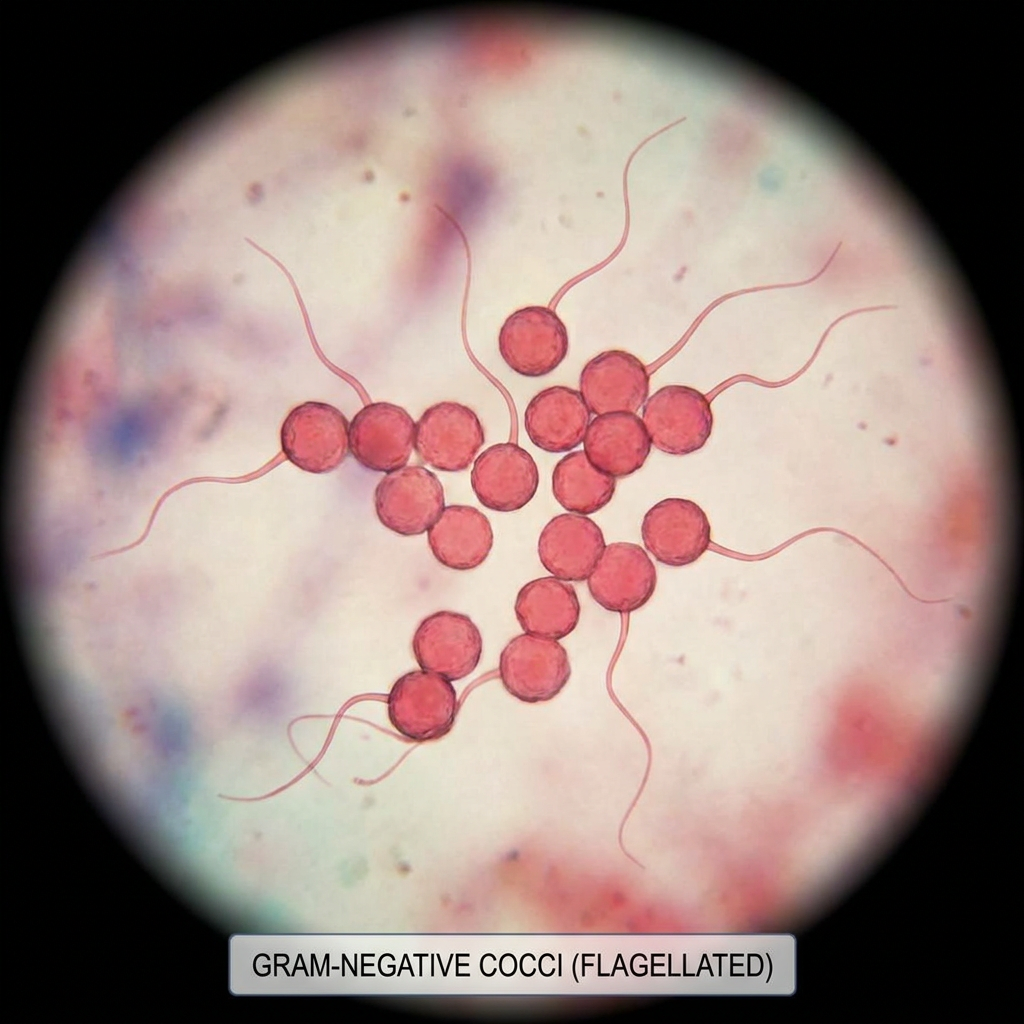
Neisseria gonorrhoeae

Gram-negativeCocciNon-motileAerobe

Kingdom

Pseudomonadati

Phylum

Pseudomonadota

Class

Betaproteobacteria

Order

Neisseriales

Family

Neisseriaceae

Genus

Neisseria

Description

Neisseria gonorrhoeae is a type of bacteria that thrives in temperatures between 32°C and 40°C, making it a mesophilic organism. It is a heterotroph, utilizing a combination of carbohydrates and amino acids as its primary energy source. This microbe produces energy through a process called respiration, which involves the breakdown of glucose and other organic compounds in the presence of oxygen. When stained with a Gram stain, N. gonorrhoeae appears as a Gram-negative bacterium, characterized by an outer membrane containing lipopolysaccharides and lipids. In terms of shape, this bacterium is a diplococcus, meaning it forms pairs of spherical cells. N. gonorrhoeae can be found in various body sites, including the genital and urinary tracts of humans, as well as the throat and eyes. It is an obligate aerobe, requiring the presence of oxygen to survive. This microbe is able to tolerate a wide range of oxygen concentrations, making it a versatile inhabitant of the human body. One of the most significant aspects of N. gonorrhoeae is its ability to cause serious infections, particularly in the genital and urinary tracts. Gonorrhea, the sexually transmitted disease caused by this bacterium, can lead to severe consequences if left untreated, including infertility, pelvic inflammatory disease, and disseminated infection. The World Health Organization (WHO) estimates that there are over 80 million cases of gonorrhea worldwide each year, highlighting the significant public health burden of this microbe. Furthermore, N. gonorrhoeae has developed resistance to many antibiotics, making the treatment of gonorrhea increasingly challenging. This bacterium's ability to adapt to changing environments and develop resistance to antimicrobial agents further underscores the importance of continued research and public health efforts to combat this significant public health threat. Overall, Neisseria gonorrhoeae is a significant microbe that requires careful management and attention to prevent the spread of disease and mitigate its impact on human health.

Taxonomy

KingdomPseudomonadati
PhylumPseudomonadota
ClassBetaproteobacteria
OrderNeisseriales
FamilyNeisseriaceae
GenusNeisseria
SpeciesNeisseria gonorrhoeae
StrainNo strain

Profile

Physiology
Gram staining propertiesNegative
ShapeCocci
MobilityNo
Flagellar presenceYes
Number of membranes2
Image of Neisseria gonorrhoeae
Image source: Wikipedia/Wikimedia
Ecology, Host, and Life Cycle
Oxygen requirementsAerobe
Optimal temperature35
Temperature rangeMesophilic
HabitatHostAssociated
Biotic relationshipFree living
Host(s)Not Available
Cell arrangementSingles - Pairs
SporulationNot Available
Energy sourceNot Available
PathogenicityNot Available

Gene Summary

Adenine Count

513093 bp

Thymine Count

511521 bp

Guanine Count

557910 bp

Cytosine Count

570289 bp

Genome Length

2160498 bp

Protein-coding Genes

2225 genes

Non-Coding Genes

86 genes

# of Chromosomes/Plasmids

24

Genes

NameLocus TagUniProtStrandCoordinatesMolecular Weight
tonb-dependent receptorEPH42_11125Not Available-1920293 - 192076918224.7
tonb-dependent receptorEPH42_11130Not Available-1920628 - 192159036290.3
hemin receptorEPH42_11135Not Available-1921812 - 192266630859.2
is1595 family transposaseEPH42_11140Not Available+1922803 - 19229053938.85
is630 family transposaseEPH42_11145Not Available+1922906 - 192329914657.9
fad-binding proteinEPH42_11155Not Available-1924400 - 19246157480.15
dead/deah box helicaseEPH42_11160Not Available-1924795 - 192616850876.3
hypothetical proteinEPH42_11165Not Available-1926192 - 19263806934.31
trna dihydrouridine synthase dusbEPH42_11170Not Available+1926382 - 192738636196.6
fis family transcriptional regulatorEPH42_11175Not Available+1927575 - 19278148788.8

Displaying genes 2021 – 2030 of 56816 in total

Metabolites

126 records
Metabolite IDMetabolite nameStructureCAS number
BASm0000237(R)-4'-phosphopantothenateC9H18NO8PChemical structure of (R)-4'-phosphopantothenateNot available
Average299.2149Da
Monoisotopic299.0770031Da
BASm00002512-dehydropantoateC6H9O4Chemical structure of 2-dehydropantoateNot available
Average145.1333Da
Monoisotopic145.050083776Da
BASm0000377(S)-malateC4H4O5Chemical structure of (S)-malateNot available
Average132.0716Da
Monoisotopic132.005873238Da
BASm0000387(6R)-5,10-methylene-5,6,7,8-tetrahydrofolateC20H21N7O6Chemical structure of (6R)-5,10-methylene-5,6,7,8-tetrahydrofolateNot available
Average455.432Da
Monoisotopic455.1564286Da
BASm0000401(S)-2-succinylamino-6-oxoheptanedioateC11H12NO8Chemical structure of (S)-2-succinylamino-6-oxoheptanedioateNot available
Average286.218Da
Monoisotopic286.0579371Da
BASm0000433malonateC3H2O4Chemical structure of malonateNot available
Average102.0456Da
Monoisotopic101.9953086Da
BASm00005275-oxopentanoateC5H7O3Chemical structure of 5-oxopentanoateNot available
Average115.109Da
Monoisotopic115.040067665Da
BASm0000642S-adenosyl-4-methylsulfanyl-2-oxobutanoateC15H19N5O6SChemical structure of S-adenosyl-4-methylsulfanyl-2-oxobutanoateNot available
Average397.406Da
Monoisotopic397.105604055Da
BASm0000848hexanoateC6H11O2Chemical structure of hexanoateNot available
Average115.1503Da
Monoisotopic115.075904596Da
BASm00008763-hydroxypyruvateC3H3O4Chemical structure of 3-hydroxypyruvateNot available
Average103.054Da
Monoisotopic103.003682157Da

Displaying 1–10 of 126 metabolites