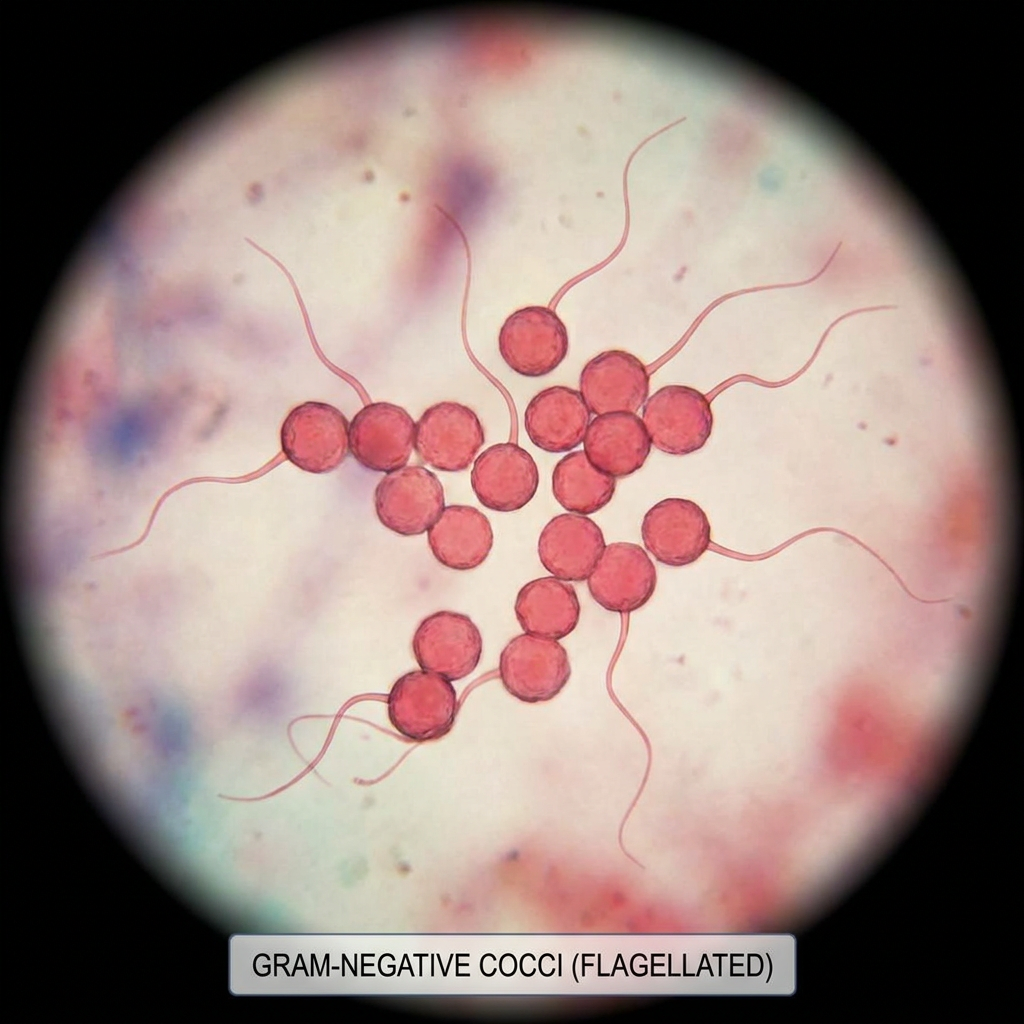
Moraxella catarrhalis

Gram-negativeCocciNon-motileAerobe

Kingdom

Pseudomonadati

Phylum

Pseudomonadota

Class

Gammaproteobacteria

Order

Moraxellales

Family

Moraxellaceae

Genus

Moraxella

Description

Moraxella catarrhalis is a gram-negative, rod-shaped bacterium that thrives in temperatures ranging from 25-40°C, classified as psychrotolerant. As a heterotroph, it derives its energy from the breakdown of organic compounds, specifically utilizing aerobic respiration as its primary means of energy production. This process involves the conversion of glucose into ATP through the citric acid cycle and oxidative phosphorylation. M. catarrhalis is characterized by its Gram-staining properties, which indicate that it has a thin peptidoglycan layer. Its rod-shaped morphology allows it to thrive in a variety of environments, including the human respiratory tract, where it can be found colonizing the nasal cavity and sinuses. In addition, it has been detected in other body sites such as the throat, ear, and skin. As an obligate aerobe, M. catarrhalis requires the presence of oxygen to survive and grow. This is reflected in its ability to thrive in the oxygen-rich environment of the human respiratory tract, where it can be found coexisting with other microorganisms. Its ability to adapt to different oxygen levels allows it to colonize diverse niches, making it a successful pathogen. Despite its ability to thrive in a variety of environments, M. catarrhalis is often associated with respiratory tract infections, particularly in individuals with compromised immune systems. Its ability to adhere to epithelial cells and produce exotoxins contributes to its pathogenic potential. Furthermore, its ability to resist the host's immune response through the production of outer membrane vesicles and adhesins enables it to evade detection and persist in the host. In conclusion, Moraxella catarrhalis is a unique microbe that has evolved to thrive in the human respiratory tract, exploiting its ability to adapt to different temperatures, oxygen levels, and metabolic conditions. Its ability to adhere to epithelial cells, produce exotoxins, and resist the host's immune response make it a successful pathogen. While it is often associated with respiratory tract infections, its ability to colonize diverse niches and resist immune detection make it a formidable opponent.

Taxonomy

KingdomPseudomonadati
PhylumPseudomonadota
ClassGammaproteobacteria
OrderMoraxellales
FamilyMoraxellaceae
GenusMoraxella
SpeciesMoraxella catarrhalis
StrainNo strain

Profile

Physiology
Gram staining propertiesNegative
ShapeCocci
MobilityNo
Flagellar presenceYes
Number of membranes2
Image of Moraxella catarrhalis
Image source: Wikipedia/Wikimedia
Ecology, Host, and Life Cycle
Oxygen requirementsAerobe
Optimal temperatureNot Available
Temperature rangeMesophilic
HabitatHostAssociated
Biotic relationshipFree living
Host(s)Not Available
Cell arrangementNot Available
SporulationNot Available
Energy sourceNot Available
PathogenicityNot Available

Gene Summary

Adenine Count

572216 bp

Thymine Count

571002 bp

Guanine Count

397975 bp

Cytosine Count

413446 bp

Genome Length

1954639 bp

Protein-coding Genes

1961 genes

Non-Coding Genes

72 genes

# of Chromosomes/Plasmids

5

Genes

NameLocus TagUniProtStrandCoordinatesMolecular Weight
hypothetical proteinAO370_1706Not Available-1629366 - 16295455976.49
outer membrane receptor protein, mostly fe transportAO370_1707Not Available+1629957 - 1632698102847.0
hypothetical proteinAO370_1708Not Available-1632718 - 16328464870.82
hypothetical proteinAO370_1709Not Available+1633104 - 163432144027.1
hypothetical proteinAO370_1710Not Available-1634350 - 16344664434.39
hypothetical proteinAO370_1711Not Available+1634420 - 163565245889.7
prolyl endopeptidaseAO370_1712Not Available+1635890 - 1638577102113.0
hypothetical proteinAO370_1713Not Available-1638533 - 16386825746.29
hypothetical proteinAO370_1714Not Available-1638766 - 16389998917.58
oligopeptidase aAO370_1715Not Available-1639005 - 164112878880.2

Displaying genes 7591 – 7600 of 9220 in total

Metabolites

135 records
Metabolite IDMetabolite nameStructureCAS number
BASm0000237(R)-4'-phosphopantothenateC9H18NO8PChemical structure of (R)-4'-phosphopantothenateNot available
Average299.2149Da
Monoisotopic299.0770031Da
BASm00002512-dehydropantoateC6H9O4Chemical structure of 2-dehydropantoateNot available
Average145.1333Da
Monoisotopic145.050083776Da
BASm00002543-hydroxy-2-methylpropanoateC4H7O3Chemical structure of 3-hydroxy-2-methylpropanoateNot available
Average103.098Da
Monoisotopic103.0400677Da
BASm0000315acetylpyruvateC5H6O4Chemical structure of acetylpyruvateNot available
Average130.099Da
Monoisotopic130.0266087Da
BASm0000377(S)-malateC4H4O5Chemical structure of (S)-malateNot available
Average132.0716Da
Monoisotopic132.005873238Da
BASm0000387(6R)-5,10-methylene-5,6,7,8-tetrahydrofolateC20H21N7O6Chemical structure of (6R)-5,10-methylene-5,6,7,8-tetrahydrofolateNot available
Average455.432Da
Monoisotopic455.1564286Da
BASm0000401(S)-2-succinylamino-6-oxoheptanedioateC11H12NO8Chemical structure of (S)-2-succinylamino-6-oxoheptanedioateNot available
Average286.218Da
Monoisotopic286.0579371Da
BASm0000403(S)-acetoinC4H8O2Chemical structure of (S)-acetoinNot available
Average88.1051Da
Monoisotopic88.0524295Da
BASm00005275-oxopentanoateC5H7O3Chemical structure of 5-oxopentanoateNot available
Average115.109Da
Monoisotopic115.040067665Da
BASm0000642S-adenosyl-4-methylsulfanyl-2-oxobutanoateC15H19N5O6SChemical structure of S-adenosyl-4-methylsulfanyl-2-oxobutanoateNot available
Average397.406Da
Monoisotopic397.105604055Da

Displaying 1–10 of 135 metabolites